HP 241 Protein Sequencer (N+C) Technical Handbook
Summary
Texas Instruments semiconductor datasheet covering features, pin diagrams, functional block description, electrical specifications, timing characteristics, application information, power supply requirements, and package mechanical drawings.
Page 1 Text Content
N-Terminal Protein Membrane 4.0 Protein Sequencer Methods Technical Note
HP 241 Protein Sequencer (N+C)
The N-terminal protein membrane The methods are: The cycle 1 method provides a 4.0 sequencer methods implement N-Terminal Protein Membrane 4.0 longer initial drying time and a the Edman degradation chemistry N-Terminal Protein Membrane pause to provide time for proper (coupling, cleavage, and conver- 4.0 (Cycle 1) HPLC column equilibration after sion) on the Hewlett-Packard col- N-Terminal Flask 4.0 switching from C-terminal sequenc- umn-based protein sequencer. PTH-Std 4.0 ing. This method also performs a Reagents 1R, 2R, 3R, and the TH- double coupling on the N-terminal Std are specific for C-terminal The column and flask methods amino acid. There is no special- sequencing and are not utilized for control all of the derivatization/ ized cycle 1 method for the flask. the N-terminal protein membrane cleavage and conversion reac- 4.0 sequencer methods. tions, respectively. The PTH Std 4.0 method delivers
10 pmol/100 µl PTH-amino acid
These methods are suitable for The sequence program controls standard solution to the on-line N-terminal sequence analysis of all of the column and flask meth- HPLC allowing the quantitation most protein samples in the low ods, and well as any cycle excep- and identification of sequenced nanomole to low picomole range tion methods. The N-terminal pro- amino acids. One may choose to which have been applied onto a tein membrane 4.0 sequencer run a PTH-standard by using PTH- Hewlett-Packard Zitex strip. Once method uses a cycle 1 column std 4.0 when scheduling a sample. dry the strip is loaded into an empty exception method. RP/SAX biphasic column. No col- umn preparation is required with this method.
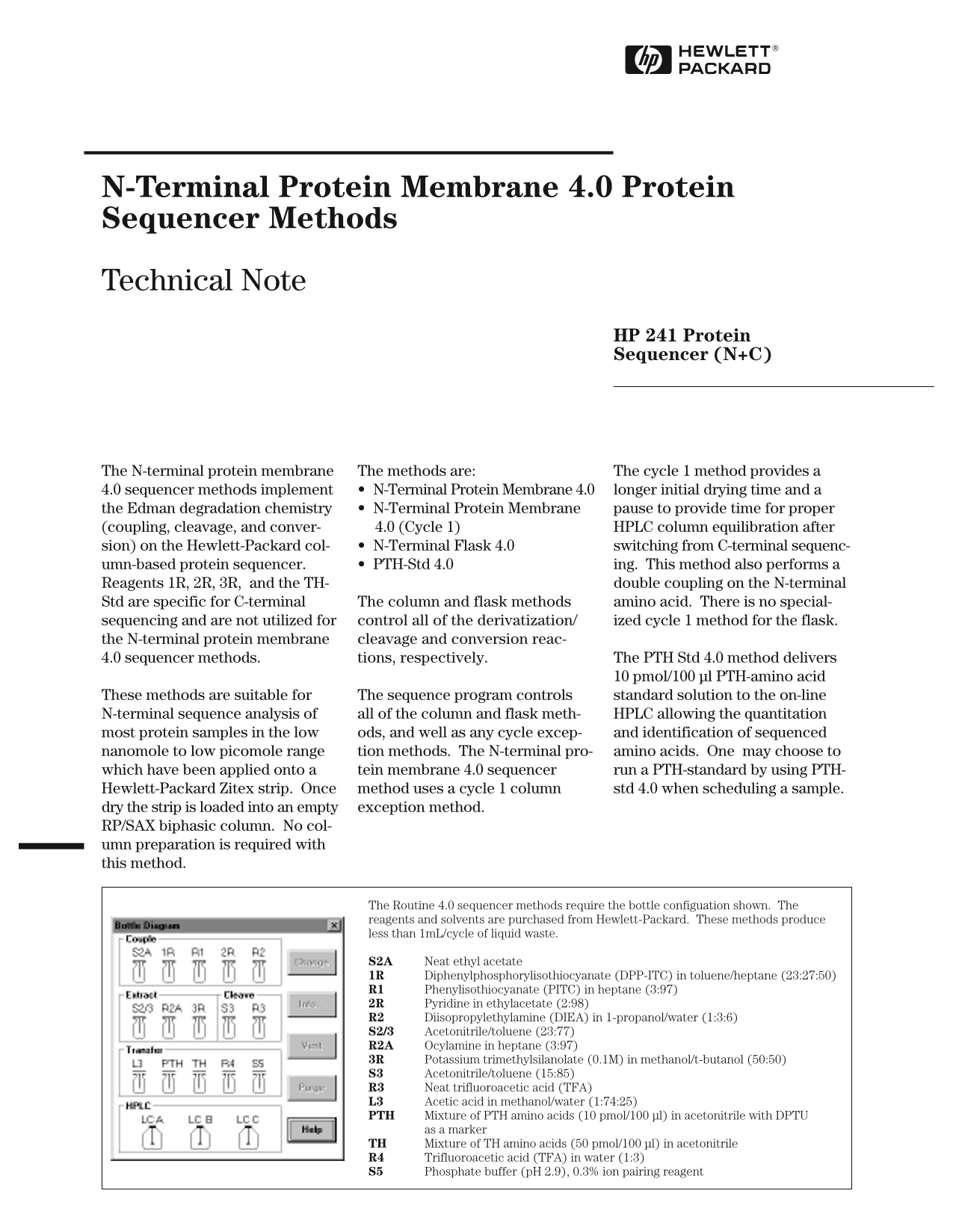
The Routine 4.0 sequencer methods require the bottle configuation shown. The reagents and solvents are purchased from Hewlett-Packard. These methods produce less than 1m L/cycle of liquid waste.
S2A Neat ethyl acetate 1R Diphenylphosphorylisothiocyanate (DPP-ITC) in toluene/heptane (23:27:50) R1 Phenylisothiocyanate (PITC) in heptane (3:97) 2R Pyridine in ethylacetate (2:98) R2 Diisopropylethylamine (DIEA) in 1-propanol/water (1:3:6) S2/3 Acetonitrile/toluene (23:77) R2A Ocylamine in heptane (3:97) 3R Potassium trimethylsilanolate (0.1M) in methanol/t-butanol (50:50) S3 Acetonitrile/toluene (15:85) R3 Neat trifluoroacetic acid (TFA) L3 Acetic acid in methanol/water (1:74:25) PTH Mixture of PTH amino acids (10 pmol/100 µl) in acetonitrile with DPTU
as a marker
TH Mixture of TH amino acids (50 pmol/100 µl) in acetonitrile R4 Trifluoroacetic acid (TFA) in water (1:3) S5 Phosphate buffer (p H 2.9), 0.3% ion pairing reagent
Page Summary Contents For HP 241 Protein Sequencer (N+C) Technical Handbook
Manual Details
| Brand | HP |
|---|---|
| Pages | 5 |
| File Size | 77.46 KB |
| Published | June 22, 2026 |
Enter the captcha to get the download link:

Frequently Asked Questions
What are the key differences between the N-Terminal and C-terminal methods?
The N-terminal method adds a longer initial drying time and allows for specialized cleavage/conversion reactions, unlike the standard C-terminal methods.
Is column preparation required for this sequence program?
No columnar preparation is required when using the specific biphasic column configuration with the N-terminal protein membrane 4.0 methods.
How can I estimate the delivery volume of PTH standards?
Copy steps 19 through 25 from the PTH Std Test 4.0 method to the clipboard and run it; then, measure the delivered volume using a syringe after removing the flask from the heating chamber.