Fairchild QSE122 Plastic Silicon Infrared Phototransistor Data Sheet
Summary
The QSE122 is a high-sensitivity NPN silicon phototransistor specifically designed for infrared detection, housed in a durable sidelooker package. This manual serves as a comprehensive technical guide, detailing absolute maximum ratings, electrical characteristics (Vce breakdown, saturation voltage), and critical optical performance parameters like dark current and light response curve. It is the essential resource for engineers designing reliable electronic sensing systems that require accurate and stable infrared measurement in diverse operational environments.
Page 1 Text Content
PLASTIC SILICON
INFRARED PHOTOTRANSISTOR
QSE122
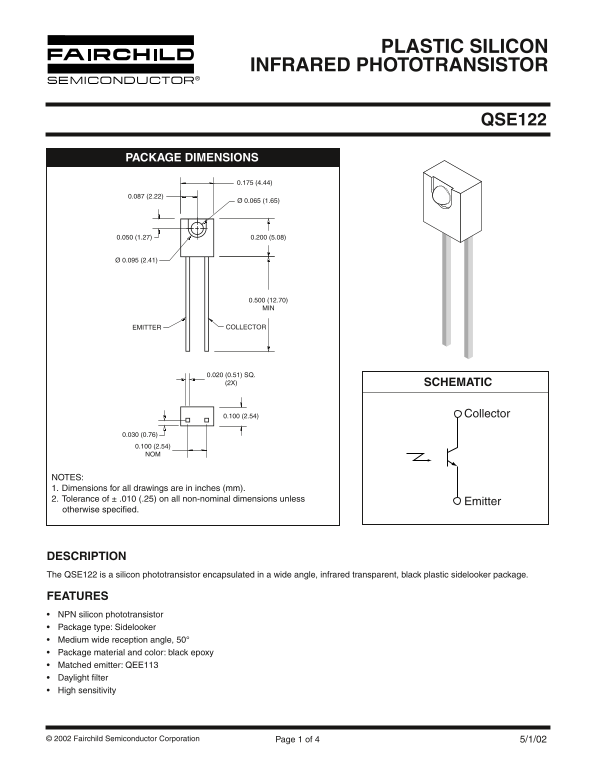
PACKAGE DIMENSIONS
0.500 (12.70) MIN
EMITTER COLLECTOR
0.020 (0.51) SQ. (2X) SCHEMATIC
0.100 (2.54) Collector
0.030 (0.76) 0.100 (2.54) NOM
NOTES: 1. Dimensions for all drawings are in inches (mm). 2. Tolerance of ± .010 (.25) on all non-nominal dimensions unless
Emitter
otherwise specified.
DESCRIPTION The QSE122 is a silicon phototransistor encapsulated in a wide angle, infrared transparent, black plastic sidelooker package.
FEATURES NPN silicon phototransistor Package type: Sidelooker Medium wide reception angle, 50° Package material and color: black epoxy Matched emitter: QEE113 Daylight filter High sensitivity
© 2002 Fairchild Semiconductor Corporation Page 1 of 4 5/1/02
Page Summary Contents For Fairchild QSE122 Plastic Silicon Infrared Phototransistor Data Sheet
Manual Details
| Brand | Fairchild |
|---|---|
| Pages | 4 |
| File Size | 327.39 KB |
| Published | June 18, 2026 |
Enter the captcha to get the download link:

Frequently Asked Questions
What is the typical operating temperature range for this device?
The operating temperature range is -40 to +100 °C.
What color and material is the package of the QSE122 phototransistor?
It is encapsulated in black epoxy plastic.
What should I use if cleaning the device after soldering?
Methanol or isopropyl alcohols are recommended as cleaning agents.
How does my power dissipation change when operating above 25°C?
You must derate the power dissipation linearly at a rate of 1.33 mW/°C above 25°C.