Fairchild Optically Isolated Phase Controlling Circuit Solution Data Handbook
Summary
Optimize AC loads with this guide to optically isolated phase control circuits. Learn how to use specialized optocouplers and TRIAC drivers to safely manage variable speed motors or lights from a 115 VAC line. This technical resource is essential for engineers designing robust solid-state relays, industrial power controls, and consumer electronics requiring reliable isolation from high mains voltage noise.
Page 1 Text Content
www.fairchildsemi.com
Application Note AN-3006 Optically Isolated Phase Controlling Circuit Solution
Introduction from 500 V/µs to 2000 V/µs, protecting the device from acci- dental triggering by ac power line transients.
Optocouplers simplify logic isolation from the ac line, power supply transformations, and the control of polyphase power
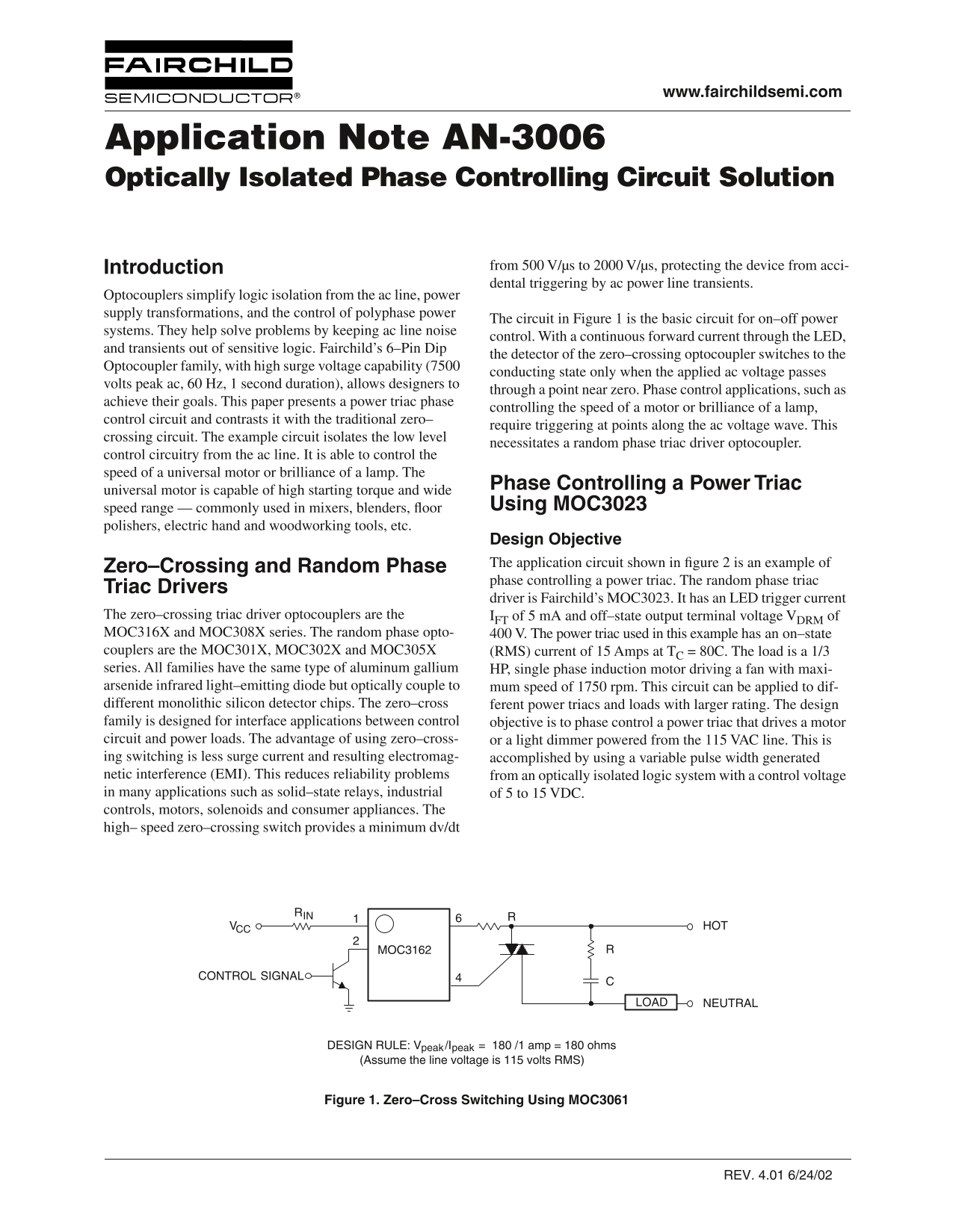
The circuit in Figure 1 is the basic circuit for on–off power
systems. They help solve problems by keeping ac line noise
control. With a continuous forward current through the LED,
and transients out of sensitive logic. Fairchild’s 6–Pin Dip
the detector of the zero–crossing optocoupler switches to the
Optocoupler family, with high surge voltage capability (7500
conducting state only when the applied ac voltage passes
volts peak ac, 60 Hz, 1 second duration), allows designers to
through a point near zero. Phase control applications, such as
achieve their goals. This paper presents a power triac phase
controlling the speed of a motor or brilliance of a lamp,
control circuit and contrasts it with the traditional zero–
require triggering at points along the ac voltage wave. This
crossing circuit. The example circuit isolates the low level
necessitates a random phase triac driver optocoupler.
control circuitry from the ac line. It is able to control the speed of a universal motor or brilliance of a lamp. The
Phase Controlling a Power Triac
universal motor is capable of high starting torque and wide
speed range — commonly used in mixers, blenders, floor Using MOC3023
polishers, electric hand and woodworking tools, etc.
Design Objective The application circuit shown in figure 2 is an example of
Zero–Crossing and Random Phase
phase controlling a power triac. The random phase triac
Triac Drivers
driver is Fairchild’s MOC3023. It has an LED trigger current
The zero–crossing triac driver optocouplers are the of 5 m A and off–state output terminal voltage V of
FT DRM
MOC316X and MOC308X series. The random phase opto- 400 V. The power triac used in this example has an on–state couplers are the MOC301X, MOC302X and MOC305X (RMS) current of 15 Amps at T = 80C. The load is a 1/3 series. All families have the same type of aluminum gallium HP, single phase induction motor driving a fan with maxi- arsenide infrared light–emitting diode but optically couple to mum speed of 1750 rpm. This circuit can be applied to dif- different monolithic silicon detector chips. The zero–cross ferent power triacs and loads with larger rating. The design family is designed for interface applications between control objective is to phase control a power triac that drives a motor circuit and power loads. The advantage of using zero–cross- or a light dimmer powered from the 115 VAC line. This is ing switching is less surge current and resulting electromag- accomplished by using a variable pulse width generated netic interference (EMI). This reduces reliability problems from an optically isolated logic system with a control voltage in many applications such as solid–state relays, industrial of 5 to 15 VDC. controls, motors, solenoids and consumer appliances. The high– speed zero–crossing switch provides a minimum dv/dt
VCC HOT
MOC3162
CONTROL SIGNAL
LOAD NEUTRAL
DESIGN RULE: Vpeak /I peak = 180 /1 amp = 180 ohms (Assume the line voltage is 115 volts RMS)
Figure 1. Zero–Cross Switching Using MOC3061
REV. 4.01 6/24/02
Page Summary Contents For Fairchild Optically Isolated Phase Controlling Circuit Solution Data Handbook
Manual Details
| Brand | Fairchild |
|---|---|
| Pages | 6 |
| File Size | 318.27 KB |
| Published | July 07, 2026 |
Enter the captcha to get the download link:

Frequently Asked Questions
What are optocouplers used for in power electronics?
They simplify logic isolation from AC lines, power supply transformations, and control of polyphase power.
Which chips are suitable for phase controlling a power triac?
The MOC301X, MOC302X, and MOC305X series are listed for this purpose. The specific driver is the MOC3023.
What advantage does zero-crossing switching offer?
It results in less surge current and reduced electromagnetic interference (EMI), improving reliability.
Does this system require expert knowledge to implement?
The provided texts describe complex circuits, suggesting specialized electronic knowledge is needed for proper designation and assembly.