Dell Latitude 3520 Statement of Volatility
Summary
The Statement of Volatility for Dell Latitude 3520 details volatile and non-volatile components. It identifies SSDs, hard drives, BIOS/EC firmware, Thunderbolt EEPROM, USB-C PD firmware, LCD EDID, and RTC CMOS with data retention characteristics. Target users are security professionals and organizations requiring data sanitization assessments.
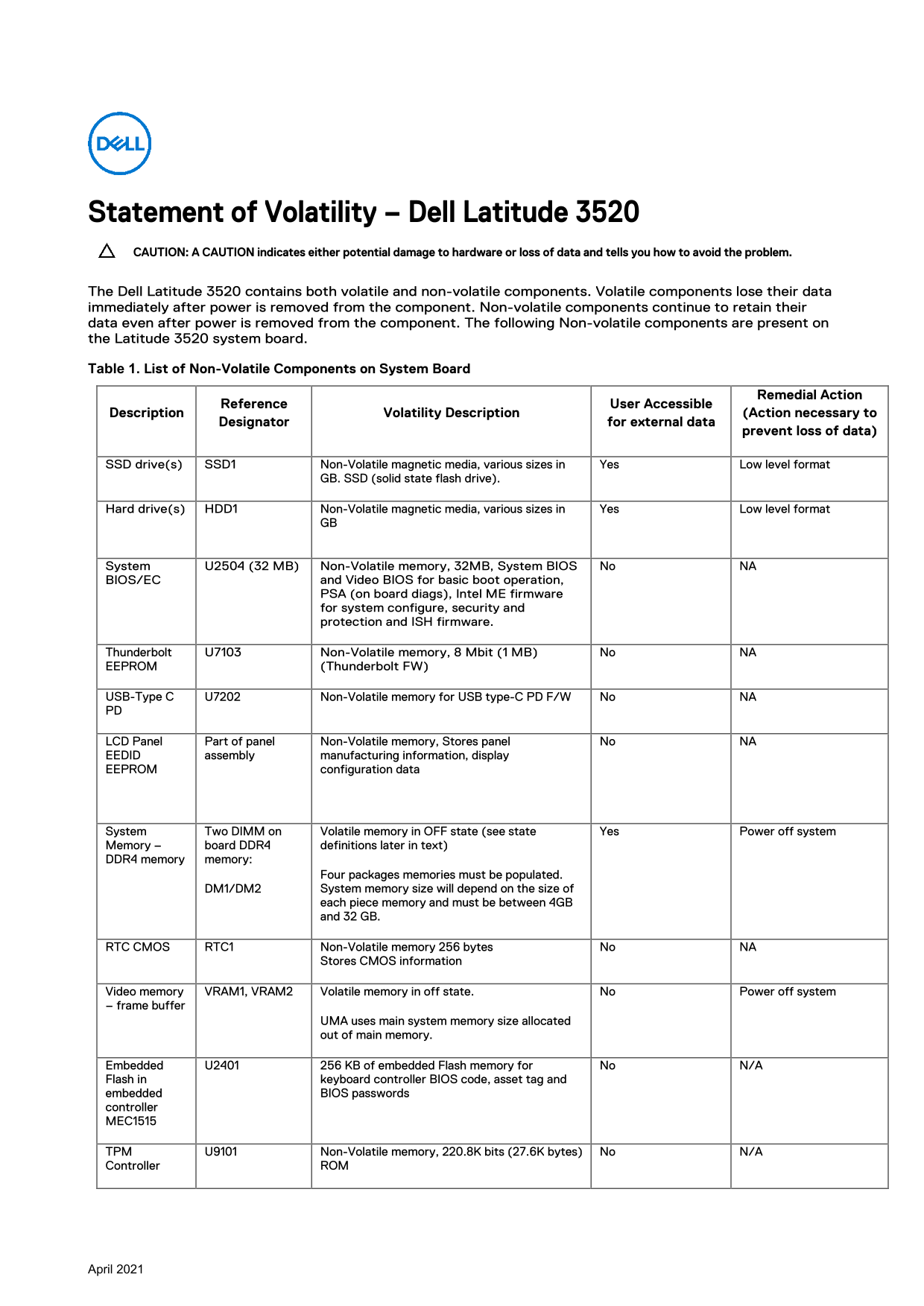
Page 1 Text Content
Statement of Volatility – Dell Latitude 3520 CAUTION: A CAUTION indicates either potential damage to hardware or loss of data and tells you how to avoid the problem. The Dell Latitude 3520 contains both volatile and non-volatile components. Volatile components lose their data immediately after power is removed from the component. Non-volatile components continue to retain their data even after power is removed from the component. The following Non-volatile components are present on the Latitude 3520 system board. Table 1. List of Non-Volatile Components on System Board
Remedial Action
Reference User Accessible
Description Volatility Description (Action necessary to
Designator for external data
prevent loss of data)
SSD drive(s) SSD1 Non-Volatile magnetic media, various sizes in Yes Low level format
GB. SSD (solid state flash drive).
Hard drive(s) HDD1 Non-Volatile magnetic media, various sizes in Yes Low level format
System U2504 (32 MB) Non-Volatile memory, 32MB, System BIOS No NA
BIOS/EC and Video BIOS for basic boot operation, PSA (on board diags), Intel ME firmware for system configure, security and protection and ISH firmware.
Thunderbolt U7103 Non-Volatile memory, 8 Mbit (1 MB) No NA EEPROM (Thunderbolt FW)
USB-Type C U7202 Non-Volatile memory for USB type-C PD F/W No NA PD
LCD Panel Part of panel Non-Volatile memory, Stores panel No NA EEDID assembly manufacturing information, display EEPROM configuration data
System Two DIMM on Volatile memory in OFF state (see state Yes Power off system Memory – board DDR4 definitions later in text) DDR4 memory memory:
Four packages memories must be populated. DM1/DM2 System memory size will depend on the size of each piece memory and must be between 4GB and 32 GB.
RTC CMOS RTC1 Non-Volatile memory 256 bytes No NA
Stores CMOS information
Video memory VRAM1, VRAM2 Volatile memory in off state. No Power off system – frame buffer
UMA uses main system memory size allocated out of main memory.
Embedded U2401 256 KB of embedded Flash memory for No N/A Flash in keyboard controller BIOS code, asset tag and embedded BIOS passwords controller MEC1515
TPM U9101 Non-Volatile memory, 220.8K bits (27.6K bytes) No N/A Controller ROM
April 2021
Page Summary Contents For Dell Latitude 3520 Statement of Volatility
Manual Details
| Brand | Dell |
|---|---|
| Pages | 2 |
| File Size | 141.33 KB |
| Published | June 25, 2026 |
Enter the captcha to get the download link:

Frequently Asked Questions
How is user data retained on the Latitude 3520?
Non-volatile components such as SSD, HDD, and BIOS retain data even after power removal.
What happens if the system's primary power cord is unplugged?
Primary power loss (unplugging the power cord) destroys all user data on the memory (DDR4).
Which small battery holds configuration and time-of-day information?
Secondary power loss involves removing the on-board coin-cell battery, which stores system configuration and time-of-day information.
What is the recommended setup range for system memory (DDR4)?
The main system memory size must be between 4GB and 32 GB.