Dell Easy Peasy NFS with RHEL6.5 User Guide and Manual
Summary
This technical blog describes the NSS5.5 (NFS Storage Solution version 5.5), a verified and benchmarked NFS solution from Dell HPC Engineering. It details the architecture using a PowerEdge R620 server with Intel Xeon E5-2600 v2 processors, four PowerVault MD1200 storage arrays, Red Hat Enterprise Linux 6.5, and InfiniBand ConnectX-3 interconnects. The document covers configuration details, RAID setup, performance tuning, and best practices for deploying a scalable NFS storage solution. It is intended for HPC administrators, storage engineers, and IT professionals seeking a simple yet scalable NFS deployment.
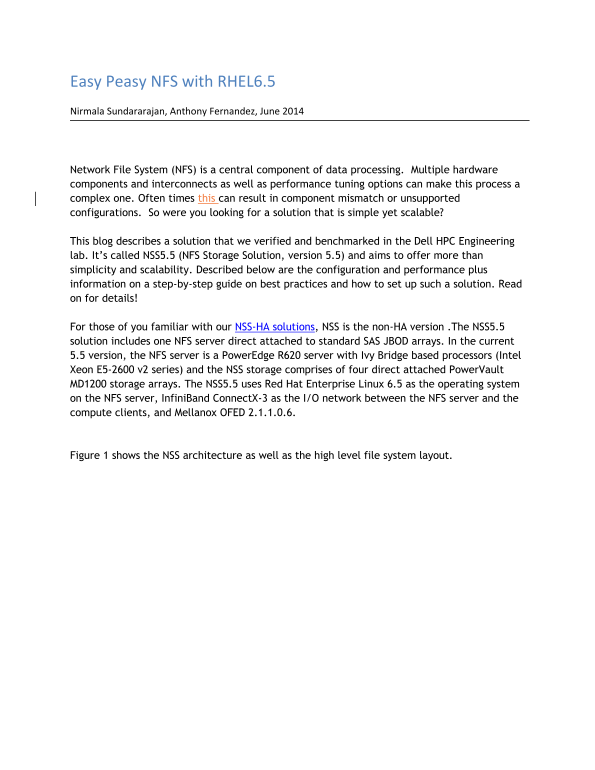
Page 1 Text Content
Easy Peasy NFS with RHEL6.5 Nirmala Sundararajan, Anthony Fernandez, June 2014
Network File System (NFS) is a central component of data processing. Multiple hardware components and interconnects as well as performance tuning options can make this process a complex one. Often times this can result in component mismatch or unsupported configurations. So were you looking for a solution that is simple yet scalable?
This blog describes a solution that we verified and benchmarked in the Dell HPC Engineering lab. It’s called NSS5.5 (NFS Storage Solution, version 5.5) and aims to offer more than simplicity and scalability. Described below are the configuration and performance plus information on a step-by-step guide on best practices and how to set up such a solution. Read on for details!
For those of you familiar with our NSS-HA solutions, NSS is the non-HA version .The NSS5.5 solution includes one NFS server direct attached to standard SAS JBOD arrays. In the current 5.5 version, the NFS server is a Power Edge R620 server with Ivy Bridge based processors (Intel Xeon E5-2600 v2 series) and the NSS storage comprises of four direct attached Power Vault MD1200 storage arrays. The NSS5.5 uses Red Hat Enterprise Linux 6.5 as the operating system on the NFS server, Infini Band Connect X-3 as the I/O network between the NFS server and the compute clients, and Mellanox OFED 2.1.1.0.6.
Figure 1 shows the NSS architecture as well as the high level file system layout.
Page Summary Contents For Dell Easy Peasy NFS with RHEL6.5 User Guide and Manual
Manual Details
| Brand | Dell |
|---|---|
| Pages | 7 |
| File Size | 792.89 KB |
| Published | May 28, 2026 |
Enter the captcha to get the download link:
