Dell Dell Dell Optiplex 7050 Tower - Statement of Volatility
Summary
This technical guide provides essential knowledge for managing system data integrity within the Dell OptiPlex 7050 MT workstation. It details component volatility, explaining which parts retain crucial information—and how—across various operational power states (S3/Sleep to RAM, S4/Hibernate, and full shutdown). Ideal for IT professionals, technicians, or systems administrators who need precise understanding of data retention protocols when configuring or troubleshooting hardware sleep modes and persistent storage.
Page 1 Text Content
Dell Inc. Telephone: 512.338.4400 One Dell Way Telefax: 512.728.3653 Round Rock, TX78682
Date: Nov 02, 2016
Subject: Statement of Volatility – Dell Opti Plex 7050_MT
To whom it may concern:
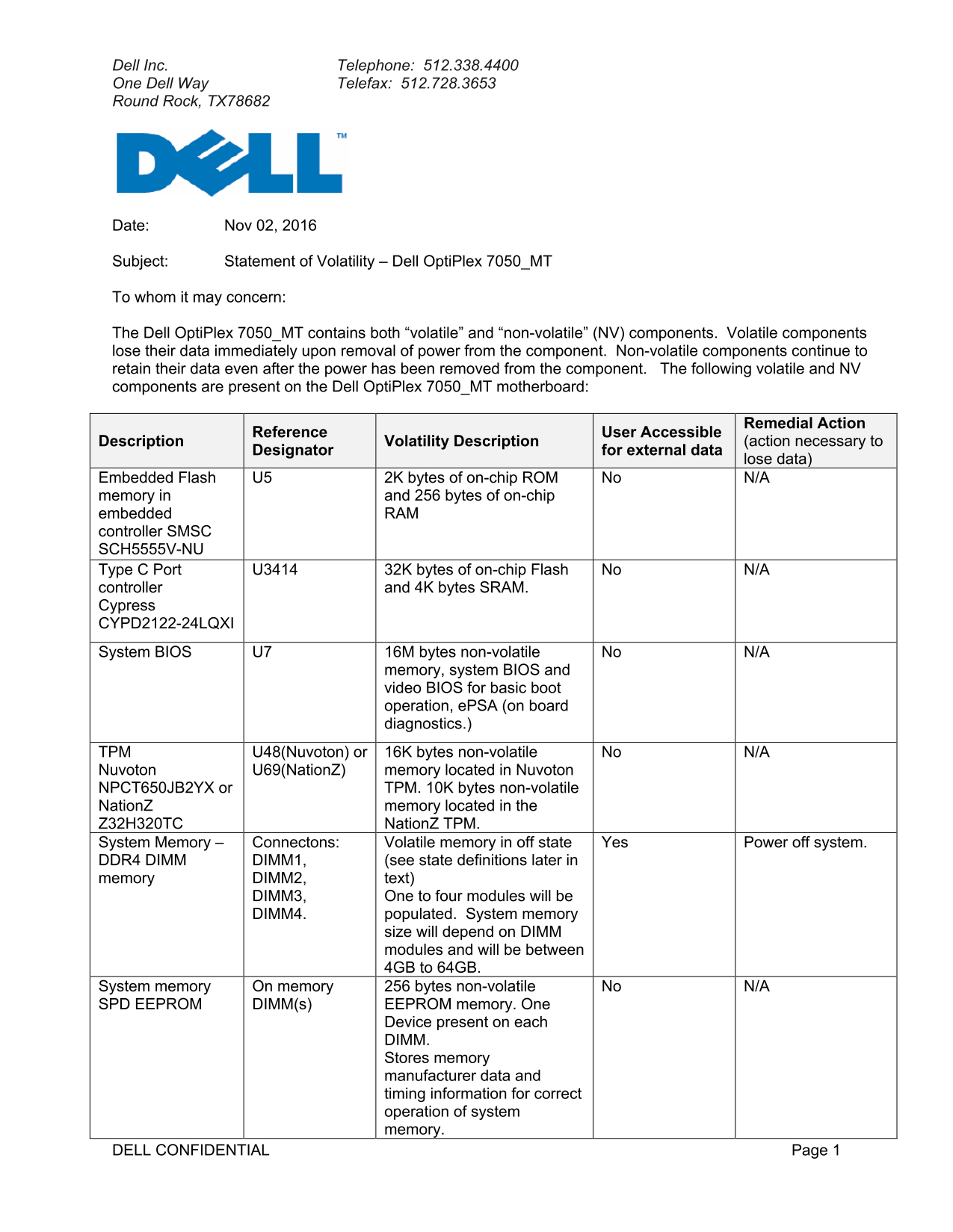
The Dell Opti Plex 7050_MT contains both “volatile” and “non-volatile” (NV) components. Volatile components lose their data immediately upon removal of power from the component. Non-volatile components continue to retain their data even after the power has been removed from the component. The following volatile and NV components are present on the Dell Opti Plex 7050_MT motherboard:
Remedial Action Description Reference (action necessary to
Designator Volatility Description User Accessible for external data
lose data)
Embedded Flash U5 2K bytes of on-chip ROM No N/A memory in and 256 bytes of on-chip embedded RAM controller SMSC SCH5555V-NU Type C Port U3414 32K bytes of on-chip Flash No N/A controller and 4K bytes SRAM. Cypress CYPD2122-24LQXI System BIOS U7 16M bytes non-volatile No N/A
memory, system BIOS and video BIOS for basic boot operation, e PSA (on board diagnostics.)
TPM U48(Nuvoton) or 16K bytes non-volatile No N/A Nuvoton U69(Nation Z) memory located in Nuvoton NPCT650JB2YX or TPM. 10K bytes non-volatile Nation Z memory located in the Z32H320TC Nation Z TPM. System Memory – Connectons: Volatile memory in off state Yes Power off system. DDR4 DIMM DIMM1, (see state definitions later in memory DIMM2, text)
DIMM3, One to four modules will be DIMM4. populated. System memory size will depend on DIMM modules and will be between 4GB to 64GB.
System memory On memory 256 bytes non-volatile No N/A SPD EEPROM DIMM(s) EEPROM memory. One
Device present on each DIMM. Stores memory manufacturer data and timing information for correct operation of system memory.
DELL CONFIDENTIAL Page 1
Page Summary Contents For Dell Dell Dell Optiplex 7050 Tower - Statement of Volatility
Manual Details
| Brand | Dell |
|---|---|
| Pages | 3 |
| File Size | 54.73 KB |
| Published | June 23, 2026 |
Enter the captcha to get the download link:

Frequently Asked Questions
What types of data components are volatile on the OptiPlex 7050_MT?
Volatile components include System Memory (DDR4 DIMM), Video memory (UMA), and the RTC CMOS Battery.
How does 'Suspend to RAM' (S3 state) work regarding data retention?
In S3 state, dynamic RAM is maintained. The system context is retained as long as the hardware supports it.
What is required for data on the Dell OptiPlex 7050_MT to be non-volatile?
Data remains non-volatile (retainable after power removal) in embedded Flash, System BIOS/video BIOS, and connected user media like M.2 or HDD. The RTC CMOS battery stores configuration info.
Does removing the main power source cause data loss on all components?
Yes, primary power loss will destroy all user data stored on DDR4 DIMM memory (Primary power loss). Secondary power loss affects system configuration and time-of-day data.