BOLT-3 DATA SHEET
Summary
The BOLT-3 is a specialized transducer engineered for accurate, simultaneous measurement of axial forces and torques applied to bolted and threaded connections. This manual provides comprehensive technical specifications, including various capacities (tensile, torque, axial) and sensitivities, crucial for selecting the right model. It is essential for engineers and researchers requiring detailed data on fastener stress, thread form analysis, or load testing in material studies.
Page 1 Text Content
BOLT-3
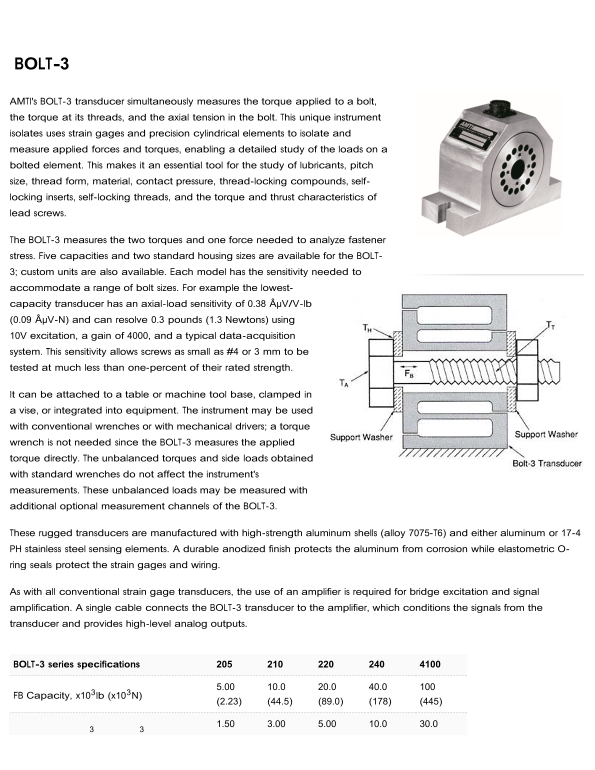
AMTI's BOLT-3 transducer simultaneously measures the torque applied to a bolt, the torque at its threads, and the axial tension in the bolt. This unique instrument isolates uses strain gages and precision cylindrical elements to isolate and measure applied forces and torques, enabling a detailed study of the loads on a bolted element. This makes it an essential tool for the study of lubricants, pitch size, thread form, material, contact pressure, thread-locking compounds, self- locking inserts, self-locking threads, and the torque and thrust characteristics of lead screws.
The BOLT-3 measures the two torques and one force needed to analyze fastener stress. Five capacities and two standard housing sizes are available for the BOLT- 3; custom units are also available. Each model has the sensitivity needed to accommodate a range of bolt sizes. For example the lowest- capacity transducer has an axial-load sensitivity of 0.38 µV/V-lb (0.09 µV-N) and can resolve 0.3 pounds (1.3 Newtons) using 10V excitation, a gain of 4000, and a typical data-acquisition system. This sensitivity allows screws as small as #4 or 3 mm to be tested at much less than one-percent of their rated strength.
It can be attached to a table or machine tool base, clamped in a vise, or integrated into equipment. The instrument may be used with conventional wrenches or with mechanical drivers; a torque wrench is not needed since the BOLT-3 measures the applied torque directly. The unbalanced torques and side loads obtained with standard wrenches do not affect the instrument's measurements. These unbalanced loads may be measured with additional optional measurement channels of the BOLT-3.
These rugged transducers are manufactured with high-strength aluminum shells (alloy 7075-T6) and either aluminum or 17-4 PH stainless steel sensing elements. A durable anodized finish protects the aluminum from corrosion while elastometric O- ring seals protect the strain gages and wiring.
As with all conventional strain gage transducers, the use of an amplifier is required for bridge excitation and signal amplification. A single cable connects the BOLT-3 transducer to the amplifier, which conditions the signals from the transducer and provides high-level analog outputs.
BOLT-3 series specifications
FB Capacity, x103lb (x103N)
Page Summary Contents For BOLT-3 DATA SHEET
Manual Details
| Brand | Bolt |
|---|---|
| Pages | 2 |
| File Size | 199.45 KB |
| Published | May 16, 2026 |
Enter the captcha to get the download link:

Frequently Asked Questions
What does the BOLT-3 measure?
It simultaneously measures torque applied to a bolt, torque at its threads, and axial tension (force) in the bolt, helping analyze fastener stress.
Do I need a specific type of wrench to use it?
No, a torque wrench is not required because the BOLT-3 measures the applied torque directly. It works with conventional wrenches or mechanical drivers.
How does the device connect to an amplifier?
A single cable connects the BOLT-3 transducer to an external amplifier, which conditions the signals and provides high-level analog outputs.
What is the recommended mounting method?
The instrument can be attached to a table or machine tool base, clamped in a vise, or integrated into existing equipment.