ST STEVAL-ISQ007V1 High-side current-sense amplifier demonstration board based on the TSC101 Owner's Manual
Summary
This demonstration board is designed for implementing high-precision current sensing using the TSC101 integrated circuit. It allows engineers to measure small voltage drops across a shunt resistor and amplify the difference into a ground-referenced output. The manual guides the use of this module, covering wide operational parameters including common-mode voltages (2.8V to 30V) and supply voltage ranges (4V to 24V), while highlighting low power consumption capabilities. This board is ideal for professionals developing robust industrial or automotive applications requiring accurate, amplified current monitoring.
Page 1 Text Content
STEVAL-ISQ007V1
High-side current-sense amplifier demonstration board
based on the TSC101
Data Brief
Features Independent supply and input common-mode voltages Wide common-mode operating range: 2.8 V to 30 V Wide common-mode surviving range: -0.3 V to 60 V (load-dump) Wide supply voltage range: 4 V to 24 V Low current consumption: ICC max is 300 µA Internally fixed gain: 20 V/V (TSC101A) 50 V/V (TSC101B) 100 V/V (TSC101C) Buffered output
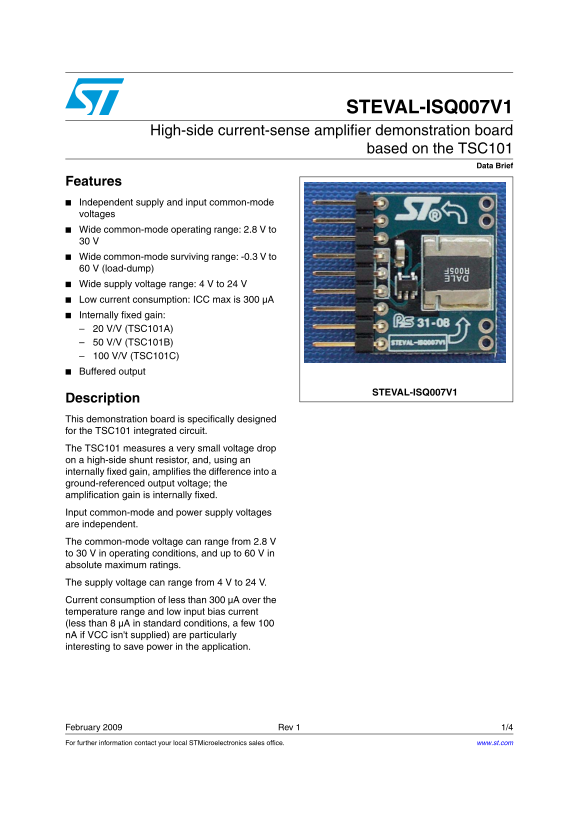
STEVAL-ISQ007V1
Description This demonstration board is specifically designed for the TSC101 integrated circuit. The TSC101 measures a very small voltage drop on a high-side shunt resistor, and, using an internally fixed gain, amplifies the difference into a ground-referenced output voltage; the amplification gain is internally fixed. Input common-mode and power supply voltages are independent. The common-mode voltage can range from 2.8 V to 30 V in operating conditions, and up to 60 V in absolute maximum ratings. The supply voltage can range from 4 V to 24 V. Current consumption of less than 300 µA over the temperature range and low input bias current (less than 8 µA in standard conditions, a few 100 n A if VCC isn't supplied) are particularly interesting to save power in the application.
February 2009 Rev 1 1/4 For further information contact your local STMicroelectronics sales office. www.st.com
Page Summary Contents For ST STEVAL-ISQ007V1 High-side current-sense amplifier demonstration board based on the TSC101 Owner's Manual
Manual Details
| Brand | Current |
|---|---|
| Pages | 4 |
| File Size | 116.96 KB |
| Published | June 03, 2026 |
Enter the captcha to get the download link:

Frequently Asked Questions
What range of common-mode voltage is supported for the TSC101 IC?
The core operating range is 2.8 V to 30 V, but it can withstand up to 60 V in absolute maximum rating.
What is the typical current consumption drawback when powering this board?
It features low power usage, with a maximum current consumption (ICC max) of only 300 µA.
How does the internal gain affect the output signal?
The amplification gain is internally fixed and determines how the difference voltage is converted into the ground-referenced output.
Are the input voltages linked to the power supply constraints?
No, the common-mode input and power supply voltages are independent of each other.