# A B C D E F G H I J K L M N O P Q R S T U V W X Y Z

Roland V-STUDIO 20 Audio Interface Control Surface with DAW Software Editor Manual

Summary

This comprehensive guide provides instructions for mastering your V-STUDIO 20 multi-effect unit using the dedicated software interface. Learn how to properly connect and configure MIDI settings to ensure optimal performance. The manual covers advanced usage, including efficient patch selection (user presets) and detailed editing of a vast array of effects. Users will gain expert knowledge on customizing everything from preamps and distortion models to stereo microphones, allowing you to perfectly tailor tones for any genre from clean jazz to heavy rock. Ideal for musicians seeking complete control over studio-quality sound processing.
📄 Preview PAGE OF 21

Page 1 Text Content

Using VS-20 Editor

1. Introduction VS-20 Editor is an application that lets you control the V-STUDIO 20’s parameters from your computer. Unless otherwise specified, this document refers to this application as “VS-20 Editor,” and the controller included with the V-STUDIO 20 as “the VS-20.”

2. Connections and settings If you’re using the V-STUDIO 20 for the first time, you’ll need to install the VS-20 driver before connecting the VS-20 to your computer. Install the driver as described in the owner’s manual included with the V-STUDIO 20. Start up VS-20 Editor after you’ve connected the VS-20 to your computer. If you start up VS-20 Editor before connecting the VS-20, it will not operate correctly.

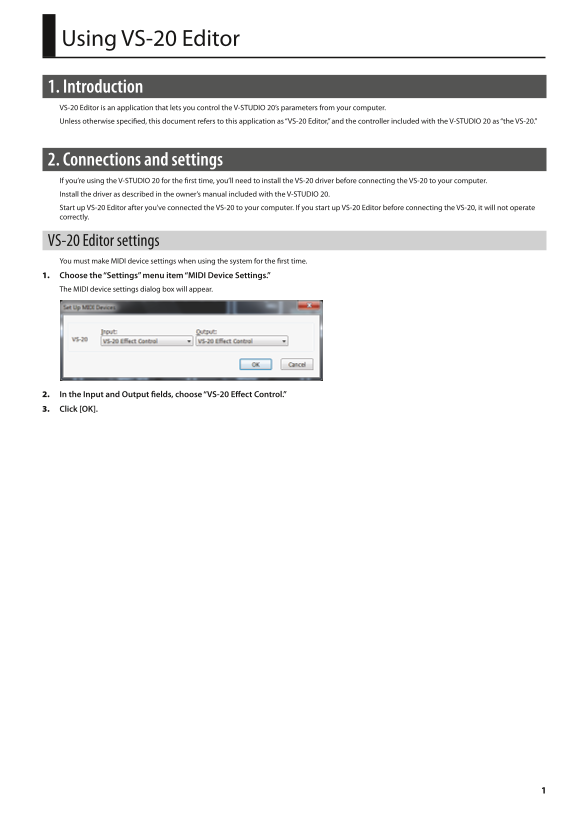
VS-20 Editor settings You must make MIDI device settings when using the system for the first time. 1. Choose the “Settings” menu item “MIDI Device Settings.” The MIDI device settings dialog box will appear.

2. In the Input and Output fields, choose “VS-20 Effect Control.” 3. Click [OK].

VS-20_editor_e01.indb 1 10/01/14 19:06

Page Summary Contents For Roland V-STUDIO 20 Audio Interface Control Surface with DAW Software Editor Manual

Page 1 Using VS-20 Editor 1. Introduction VS-20 Editor is an application that lets you control the V-STUDIO 20’s parameters from your computer. Unless otherwise specified, this document refers to this applic...
Page 2 Selecting and editing patches Selecting a patch A collection of settings determining how eff ects are combined and including settings for the parameters is called a “patch.” By switching patches you c...
Page 3 Editing a patch Turning eff ects on/off You can turn an eff ect on/off by clicking the indicator located in the upper left of the eff ect, or by clicking a foot switch. Switching eff ects 1. Click the...
Page 4 Editing an eff ect (Detail) In this mode you can edit the parameters in detail, as well as turn each eff ect on/off . Company names and product names appearing here are the trademarks or registered tr...
Page 5 PREAMP/VOCAL You can use [PREAMP] or [VOCAL] to change the eff ect. Caution! “PREAMP” and VOCAL “HARMONY” and “PITCH CORRECT” cannot be used simultaneously. The on/off setting is shared by these three...
Page 6 VOCAL VOCAL provides two eff ects: “HARMONY,” which lets you easily add harmony to one person’s singing, and “PITCH CORRECT,” which constrains pitch change in a stair-step manner. Use the MODE switche...
Page 7 COMP/FX (Compressor/Eff ect) Here you can choose eff ects that keep the volume consistent or produce sustain without distortion, as well as various other distinctive eff ects. COMPRESSOR Produces sust...
Page 8 OD/DS (Overdrive/Distortion) This eff ect distorts the sound to create sustain or a distinctive tone. In addition to operating as a booster, this eff ect can be BOOSTER used on its own to produce a pu...
Page 9 MODULATION This eff ect adds spaciousness or movement to the sound. A stereo eff ect that adds a slightly modulated sound to CHORUS the input, giving it beautiful spaciousness and depth. An eff ect th...
Page 10 DELAY This eff ect delays the sound to produce echoes. You can use it to make the sound thicker, or to create special eff ects. SINGLE This is a 1–2000 ms (millisecond) delay. This delay is only for s...
Page 11 REVERB This adds reverberation to the sound. TYPE ROOM Simulates the reverberation of a room. (Range: 0–50) HALL Simulates the reverberation of a hall. (Range: 0–50) MASTER/NOISE SUPPRESSOR Here you c...
Page 12 Saving a patch Naming a patch 1. Click the patch name. A text box will appear. 2. Enter the desired patch name. Caution! The following characters cannot be used in the patch name. ¥ (backslash), / (sl...
Page 13 Convenient functions Using the tuner 1. Click the [TUNER] button. 2. If necessary, specify the reference pitch. With the factory settings, the reference pitch is set to 440 Hz. You can change this in ...
Page 14 System settings for the V-STUDIO 20 Input/output settings 1. Click [SETTING]. The System Setting screen will appear. Function Explanation INPUT SENS *1 Adjusts the input sensitivity. Adjust this until...
Page 15 Recording without eff ects, and applying eff ects later (DRY REC or Re-AMP mode) If you want to record the sound unprocessed by eff ects, and then try out various eff ect settings later, you can combi...
Page 16 Recording MIC2 and GUITAR simultaneously (SIMUL mode) This mode is convenient for an instrumentalist/vocalist who wants to record their guitar and vocal simultaneously. The GUITAR/BASS input is output...
Page 17 Using an expression pedal (EXP PEDAL) If a separately sold expression pedal is connected, you can use it to do the following things. Assignable functions Explanation PEDAL WAH If the COMP/FX eff ect t...
Page 18 Initializing the patch (INIT PATCH) Here’s how to set all patch parameters to their default state. 1. In the System Setting screen, click [PATCH INIT]. The message “xxx” will appear. 2. If you’re sure...
Page 19 Troubleshooting Problems with the sound Symptom Points to check Action Could “INPUT SENS” be too low? Make sure that the VS-20’s [SENS] knob and the System Setting screen’s INPUT SENS setting are not ...
Page 20 Patch List No. Patch Name Explanation PICKUP ROCK LEAD Well sustained distortion sound, good for solos. S/H CLEAN CHORUS Clean sound for arpeggio. S/H BLUES LEAD Drive sound for blues. S/H METAL RIFF ...
Page 21 Copyright © 2010 ROLAND CORPORATION All rights reserved. No part of this publication may be reproduced in any form without the written permission of ROLAND CORPORATION. Microsoft, Windows and Windows ...

Manual Details

Brand Roland
Pages 21
File Size 10.90 MB
Published May 27, 2026
89 views

Enter the captcha to get the download link:

captcha

Frequently Asked Questions

What is the proper setup order for using the system?

You must first install the VS-20 driver, then connect the V-STUDIO 20 to your computer before starting up the Editor.

How do I change or edit the settings of an effect in detail?

Click [DETAIL] to view the Detail screen, which allows you to edit parameters by dragging the knobs and turn effects on/off.

What happens if I modify a patch but fail to save it?

If you exit VS-20 Editor or switch patches before writing any modifications, all your changes will be lost.

Are there conflict restrictions among the microphone/vocal effects?

The PREAMP, VOCAL HARMONY, and PITCH CORRECT effects cannot be used simultaneously because their on/off setting is shared.