Linear Design Features: LTC3852 - Theoretical Insights by Theo Phillips
Summary
The LTC3852 is a robust synchronous step-down DC/DC controller engineered for challenging electrical environments, particularly automotive applications. It ensures highly stable 5V gate drive and regulated power output even when input voltages drop below nominal operating levels (such as during cold crank events). The documentation details the device's integrated charge pump architecture and wide operational voltage range (2.7V to 38V), making it essential for electronics designers needing reliable intermediate bus regulation despite severe input transients or low battery states.
Page 1 Text Content
Intermediate Bus Buck Regulator Maintains 5V Gate Drive During Automobile Cold Crank Conditions
Theo Phillips and Tick Houk
DC/DC converters in today’s automobiles often take their inputs from a loosely regulated 5V intermediate bus, instead of directly from the battery voltage (which can vary from 4V during cold crank to above 24V from double-battery jump-starts and other transients). Incorporating an intermediate voltage bus has a number of advantages, one of which is the expanded range of DC/DC converter options available to power downstream electronics. Power supply designers can choose from a wide variety of low dropout (LDO)
MODE/PLLIN
and switching post-regulators that have 6V absolute maximum input voltage ratings.
LTC3852 (BUCK REGULATOR)
Because typical post-regulator outputs are substantially lower than 5V—from 3.3V down VIN2
to 1V—they can continue to operate even as their inputs drop below the nominal 5V. 5V REGMODE/SYNC
FREQ/ DETECT
With this in mind, the ideal intermediate step-down regulator would continue to provide PLLFLTR VIN 38V MAX
PLL-SYNC
power even under cold crank conditions, where the battery voltage can drop below 5V. BOOST
BURSTEN
A synchronous buck regulator often Buck regulator controllers have tradition- voltage drops below the minimum speci- OSC
PULSE SKIP M1
makes the best intermediate bus con- ally provided gate drive power through fied VGS rating of the power MOSFETs.
verter for these applications because either an external 5V supply or through ON SWITCH
BEST OF BOTH WORLDS 5k
LOGIC
of its high efficiency over a wide input an onboard LDO. Both of these supply AND SENSE+
The LTC3852 is a synchronous step-
ICMP ANTI-
IREV VOUT
range when compared to linear regula- options can only step down an input volt-
SHOOT
down DC/DC controller with a low volt- SENSE–
THROUGH
tors. In this buck topology, 40V MOSFETs age, so the gate drive potential drops with
age charge pump designed to provide
are necessary to tolerate double bat- the input voltage, limiting the operating INTVCC
5V drive to external MOSFETs even when
tery and high voltage transients, so the range of the regulator. The ideal control-
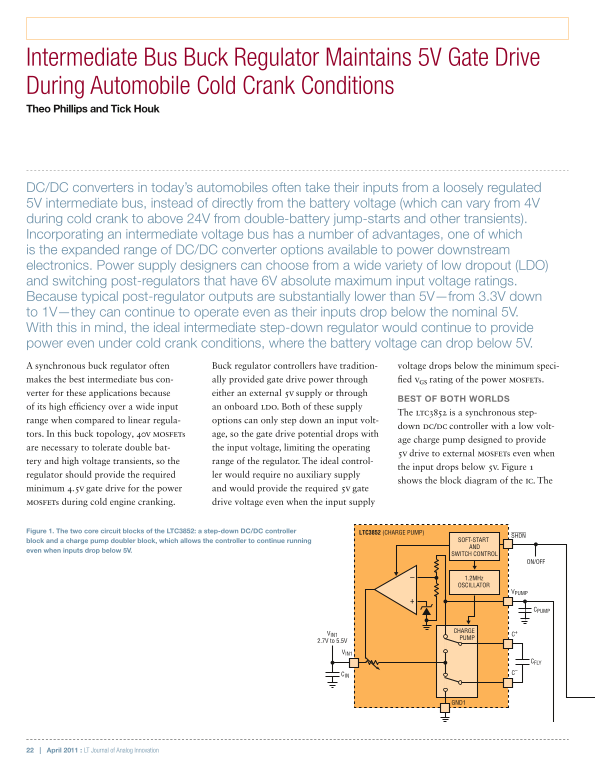
the input drops below 5V. Figure 1 OV BG
regulator should provide the required ler would require no auxiliary supply
shows the block diagram of the IC. The CINTVCC
minimum 4.5V gate drive for the power and would provide the required 5V gate SLOPE COMPENSATION
MOSFETs during cold engine cranking. drive voltage even when the input supply GND2
PGOOD
INTVCC
Figure 1. The two core circuit blocks of the LTC3852: a step-down DC/DC controller UVLO
LTC3852 (CHARGE PUMP)
block and a charge pump doubler block, which allows the controller to continue running SOFT-START 100k AND
even when inputs drop below 5V.
SWITCH CONTROL ITHB
ON/OFF
UV VFB
1.2MHz OSCILLATOR
VPUMP
FAULT LOGIC
CPUMP
RC VIN2SLEEP
CHARGE 0.88V
VIN1 C+
PUMP RUN–
2.7V to 5.5V SS
0.8V VIN1 REF 2µA 1µA
TRACK/SS
CIN C–
0.4V CSS
22 | April 2011 : LT Journal of Analog Innovation
Page Summary Contents For Linear Design Features: LTC3852 - Theoretical Insights by Theo Phillips
Manual Details
| Brand | Linear |
|---|---|
| Pages | 4 |
| File Size | 1.79 MB |
| Published | May 31, 2026 |
Enter the captcha to get the download link:

Frequently Asked Questions
What is the minimum input voltage for operation?
The LTC3852 can operate with inputs as low as 2.7V.
How does the device maintain gate drive voltage during a cold crank event?
Its integrated low voltage charge pump provides the necessary 5V gate drive, even when the input supply drops below 5V.
What is the maximum operating voltage range?
The device can operate over a wide input voltage range, ranging from 2.7V up to 38V.
Does this regulator require an external supply for gate drive?
No, it does not require any external gate drive supply; the charge pump handles this internally.