Linear Design Features - LTJournal-V20N2-07-di-LTM9003-Todd_Nelson
Summary
Simplify complex RF signal processing with this highly integrated DPD receiver module. Designed for cellular communication engineers, it consolidates passive filtering, mixers, and high-resolution ADCs into a tiny µModule package. This solution drastically reduces board space, simplifies layout, and ensures optimal performance for challenging base station applications, making professional implementation straightforward.
Page 1 Text Content
Tiny Digital Predistortion Receiver Integrates RF, Filter and ADC Todd Nelson
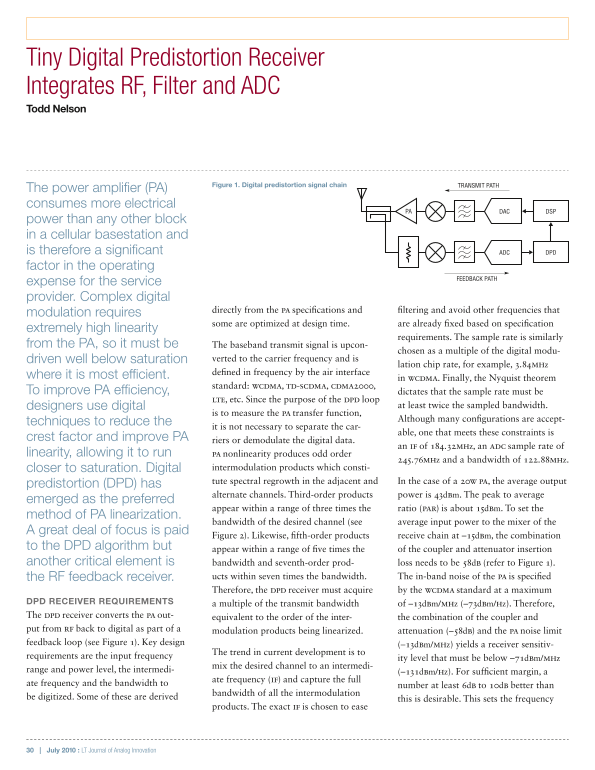
Figure 1. Digital predistortion signal chain TRANSMIT PATH
The power amplifier (PA) consumes more electrical
PA DAC DSP
power than any other block in a cellular basestation and is therefore a significant ADC DPD factor in the operating
FEEDBACK PATH
expense for the service provider. Complex digital
directly from the PA specifications and filtering and avoid other frequencies that
modulation requires
some are optimized at design time. are already fixed based on specification
extremely high linearity
requirements. The sample rate is similarly
from the PA, so it must be The baseband transmit signal is upcon-
chosen as a multiple of the digital modu-
driven well below saturation verted to the carrier frequency and is
lation chip rate, for example, 3.84MHz
defined in frequency by the air interface
where it is most efficient. in WCDMA. Finally, the Nyquist theorem
standard: WCDMA, TD-SCDMA, CDMA2000,
To improve PA efficiency, dictates that the sample rate must be
LTE, etc. Since the purpose of the DPD loop
designers use digital at least twice the sampled bandwidth.
is to measure the PA transfer function,
Although many configurations are accept-
techniques to reduce the
it is not necessary to separate the car-
able, one that meets these constraints is
crest factor and improve PA riers or demodulate the digital data.
an IF of 184.32MHz, an ADC sample rate of
linearity, allowing it to run PA nonlinearity produces odd order
245.76MHz and a bandwidth of 122.88MHz.
closer to saturation. Digital intermodulation products which consti- tute spectral regrowth in the adjacent and In the case of a 20W PA, the average output
predistortion (DPD) has
alternate channels. Third-order products power is 43d Bm. The peak to average
emerged as the preferred
appear within a range of three times the ratio (PAR) is about 15d Bm. To set the
method of PA linearization.
bandwidth of the desired channel (see average input power to the mixer of the
A great deal of focus is paid
Figure 2). Likewise, fifth-order products receive chain at –15d Bm, the combination
to the DPD algorithm but appear within a range of five times the of the coupler and attenuator insertion another critical element is bandwidth and seventh-order prod- loss needs to be 58d B (refer to Figure 1).
the RF feedback receiver. ucts within seven times the bandwidth. The in-band noise of the PA is specified Therefore, the DPD receiver must acquire by the WCDMA standard at a maximum
DPD RECEIVER REQUIREMENTS a multiple of the transmit bandwidth of –13d Bm/MHz (–73d Bm/Hz). Therefore, The DPD receiver converts the PA out- equivalent to the order of the inter- the combination of the coupler and put from RF back to digital as part of a modulation products being linearized. attenuation (–58d B) and the PA noise limit feedback loop (see Figure 1). Key design (–13d Bm/MHz) yields a receiver sensitiv-
The trend in current development is to
requirements are the input frequency ity level that must be below –71d Bm/MHz
mix the desired channel to an intermedi-
range and power level, the intermedi- (–131d Bm/Hz). For sufficient margin, a
ate frequency (IF) and capture the full
ate frequency and the bandwidth to number at least 6d B to 10d B better than
bandwidth of all the intermodulation
be digitized. Some of these are derived this is desirable. This sets the frequency
products. The exact IF is chosen to ease
30 | July 2010 : LT Journal of Analog Innovation
Page Summary Contents For Linear Design Features - LTJournal-V20N2-07-di-LTM9003-Todd_Nelson
Manual Details
| Brand | Linear |
|---|---|
| Pages | 3 |
| File Size | 770.39 KB |
| Published | June 20, 2026 |
Enter the captcha to get the download link:

Frequently Asked Questions
What is the primary function of Digital Predistortion (DPD)?
It linearizes PA nonlinearity, improving PA efficiency and spectral regrowth.
What are the DPD receiver requirements?
Minimum sensitivity levels must be maintained across different bandwidths for efficient signal capture and digitization.
How does µModule packaging benefit design?
It integrates key components into a small area, simplifying layout and reducing board space/revisions.