Intel White Paper on Applying the Advantages of Network-on-Chip Architecture to FPGA System Design
Summary
Designed for system architects and engineers building high-density, complex FPGA systems, this guide provides a deep dive into Network on a Chip (NoC) architecture. Learn how Intel’s Platform Designer creates superior, flexible interconnects that operate like optimized protocol stacks. Discover how adopting NoC technology allows designers to achieve significantly higher operating frequencies and maximize resource efficiency compared to traditional methods, streamlining the design of next-generation, scalable hardware systems with minimum effort.
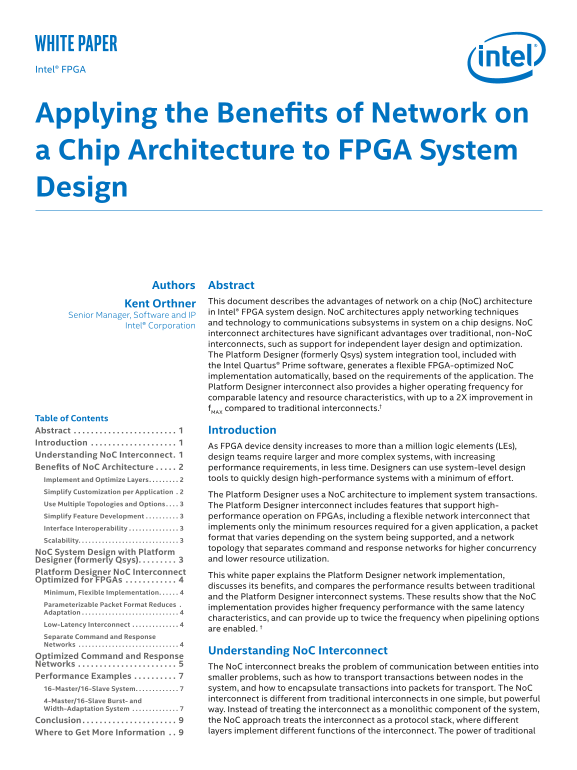
Page 1 Text Content
white paper Intel® FPGA
Applying the Benefits of Network on a Chip Architecture to FPGA System Design
Authors Abstract
This document describes the advantages of network on a chip (No C) architecture
Kent Orthner
in Intel® FPGA system design. No C architectures apply networking techniques
Senior Manager, Software and IP
and technology to communications subsystems in system on a chip designs. No C
Intel® Corporation
interconnect architectures have significant advantages over traditional, non-No C interconnects, such as support for independent layer design and optimization. The Platform Designer (formerly Qsys) system integration tool, included with the Intel Quartus® Prime software, generates a flexible FPGA-optimized No C implementation automatically, based on the requirements of the application. The Platform Designer interconnect also provides a higher operating frequency for comparable latency and resource characteristics, with up to a 2X improvement in f MAX compared to traditional interconnects.†
Table of Contents Abstract Introduction Introduction
As FPGA device density increases to more than a million logic elements (LEs),
Understanding No C Interconnect . design teams require larger and more complex systems, with increasing Benefits of No C Architecture . performance requirements, in less time. Designers can use system-level design
Implement and Optimize Layers . tools to quickly design high-performance systems with a minimum of effort.
Simplify Customization per Application
The Platform Designer uses a No C architecture to implement system transactions.
Use Multiple Topologies and Options . The Platform Designer interconnect includes features that support high- Simplify Feature Development . performance operation on FPGAs, including a flexible network interconnect that
Interface Interoperability . implements only the minimum resources required for a given application, a packet format that varies depending on the system being supported, and a network
Scalability .
topology that separates command and response networks for higher concurrency
No C System Design with Platform
Designer (formerly Qsys) . and lower resource utilization.
Platform Designer No C Interconnect
This white paper explains the Platform Designer network implementation,
Optimized for FPGAs
discusses its benefits, and compares the performance results between traditional
Minimum, Flexible Implementation .
and the Platform Designer interconnect systems. These results show that the No C
Parameterizable Packet Format Reduces .
implementation provides higher frequency performance with the same latency
Adaptation .
characteristics, and can provide up to twice the frequency when pipelining options
Low-Latency Interconnect
are enabled. †
Separate Command and Response Networks
Understanding No C Interconnect
Optimized Command and Response Networks
The No C interconnect breaks the problem of communication between entities into
Performance Examples smaller problems, such as how to transport transactions between nodes in the
16-Master/16-Slave System . system, and how to encapsulate transactions into packets for transport. The No C 4-Master/16-Slave Burst- and interconnect is different from traditional interconnects in one simple, but powerful
Width-Adaptation System way. Instead of treating the interconnect as a monolithic component of the system,
Conclusion . the No C approach treats the interconnect as a protocol stack, where different Where to Get More Information layers implement different functions of the interconnect. The power of traditional
Page Summary Contents For Intel White Paper on Applying the Advantages of Network-on-Chip Architecture to FPGA System Design
Manual Details
| Brand | Intel |
|---|---|
| Pages | 9 |
| File Size | 401.83 KB |
| Published | June 05, 2026 |
Enter the captcha to get the download link:

Frequently Asked Questions
What tool is used to implement an optimized NoC interconnect?
The Platform Designer system integration tool, which is included with the Intel Quartus Prime software.
How does the NoC architecture improve performance over traditional methods?
It provides a higher operating frequency for comparable latency, potentially offering up to a 2X improvement.
What conceptual advantage does NoC provide in system design?
It treats the interconnect as a protocol stack, allowing functional layers to be designed and optimized independently.
What feature improves concurrency within the network?
The NoC supports separate command and response networks for higher concurrency and lower resource utilization.