Dell P2715Q Statement of Volatility
Summary
Statement of Volatility document for Dell P2715Q 27-inch 4K Ultra HD monitor, detailing volatile and non-volatile memory components on the system board. Catalogs EEPROM chips storing EDID data, serial flash ROM for firmware, DDR2 SDRAM video memory, and HDMI EEPROM with their data retention properties and write protection status. Specifies remedial actions for data destruction. Intended for security and compliance personnel responsible for data sanitization during monitor disposal or transfer.
Page 1 Text Content
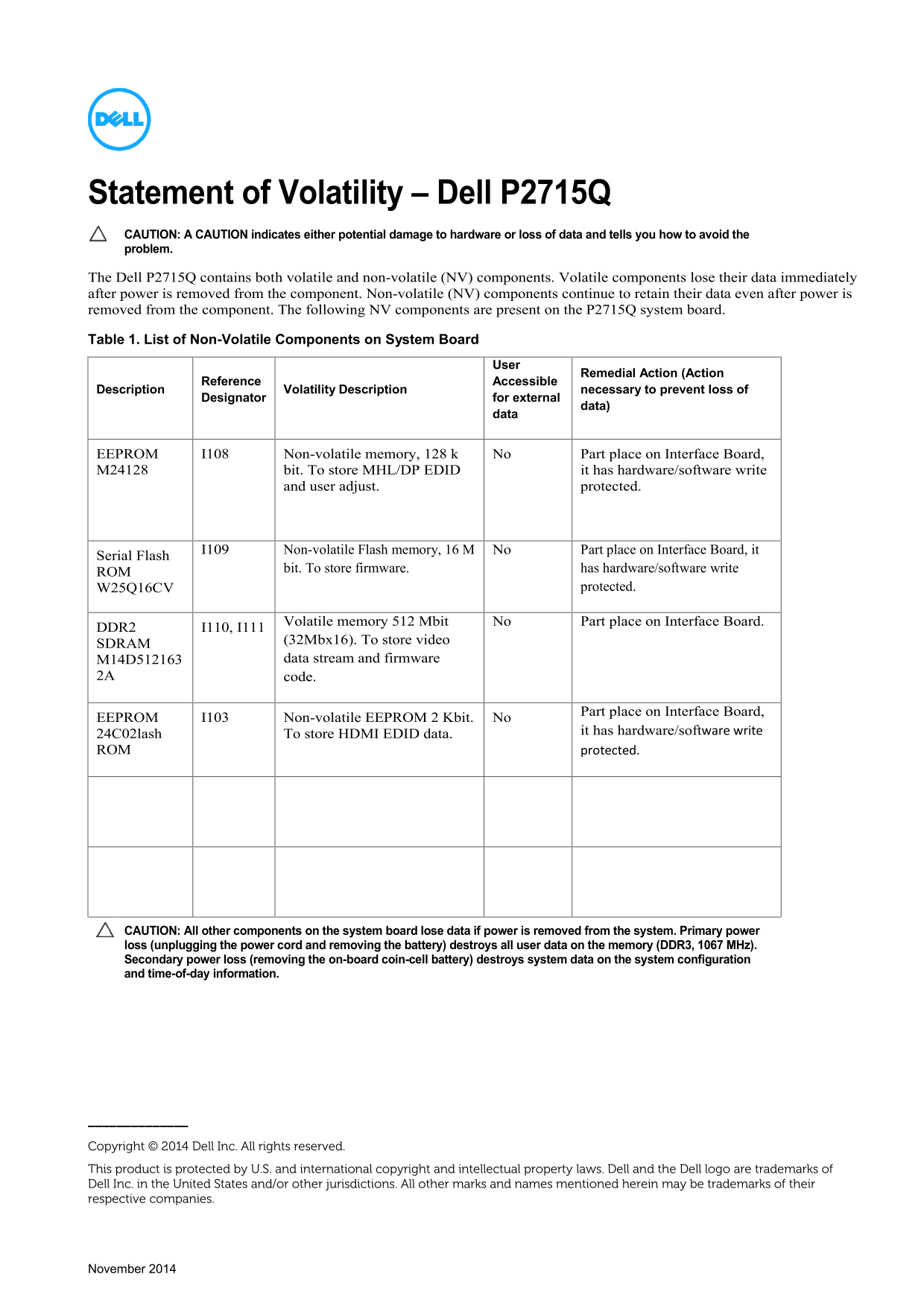
Statement of Volatility – Dell P2715Q CAUTION: A CAUTION indicates either potential damage to hardware or loss of data and tells you how to avoid the problem. The Dell P2715Q contains both volatile and non-volatile (NV) components. Volatile components lose their data immediately after power is removed from the component. Non-volatile (NV) components continue to retain their data even after power is removed from the component. The following NV components are present on the P2715Q system board. Table 1. List of Non-Volatile Components on System Board
Remedial Action (Action
Accessible
Description Reference necessary to prevent loss of
Designator Volatility Description for external
data)
EEPROM I108 Non-volatile memory, 128 k No Part place on Interface Board, M24128 bit. To store MHL/DP EDID it has hardware/software write
and user adjust. protected.
I109 Non-volatile Flash memory, 16 M No Part place on Interface Board, it
Serial Flash
bit. To store firmware. has hardware/software write
W25Q16CV protected.
No Part place on Interface Board.
DDR2 I110, I111 Volatile memory 512 Mbit
(32Mbx16). To store video
SDRAM
M14D512163 data stream and firmware
2A code.
EEPROM I103 Non-volatile EEPROM 2 Kbit. No Part place on Interface Board,
24C02lash To store HDMI EDID data. it has hardware/software write
ROM protected.
CAUTION: All other components on the system board lose data if power is removed from the system. Primary power loss (unplugging the power cord and removing the battery) destroys all user data on the memory (DDR3, 1067 MHz). Secondary power loss (removing the on-board coin-cell battery) destroys system data on the system configuration and time-of-day information.
Copyright © 2014 Dell Inc. All rights reserved. This product is protected by U.S. and international copyright and intellectual property laws. Dell and the Dell logo are trademarks of Dell Inc. in the United States and/or other jurisdictions. All other marks and names mentioned herein may be trademarks of their respective companies.
November 2014
Page Summary Contents For Dell P2715Q Statement of Volatility
Manual Details
| Brand | Dell |
|---|---|
| Pages | 1 |
| File Size | 69.70 KB |
| Published | June 26, 2026 |
Enter the captcha to get the download link:

Frequently Asked Questions
What is the difference between volatile and non-volatile memory components?
Volatile components lose data immediately after power removal, while non-volatile (NV) components retain data even when power is removed.
Which system board components store user data in a persistent manner?
The P2715Q retains data on EEPROM I108 and Flash memory I109, which are described as non-volatile (NV) components.
What happens if the primary power is lost by unplugging the cord?
Primary power loss destroys all user data stored on the DDR3 memory (1067 MHz).
Does removing the coin-cell battery affect stored system information?
Secondary power loss (removing the coin-cell battery) destroys system configuration and time-of-day information.