Dell OptiPlex 5000 Micro Statement of Volatility Owner's Manual
Summary
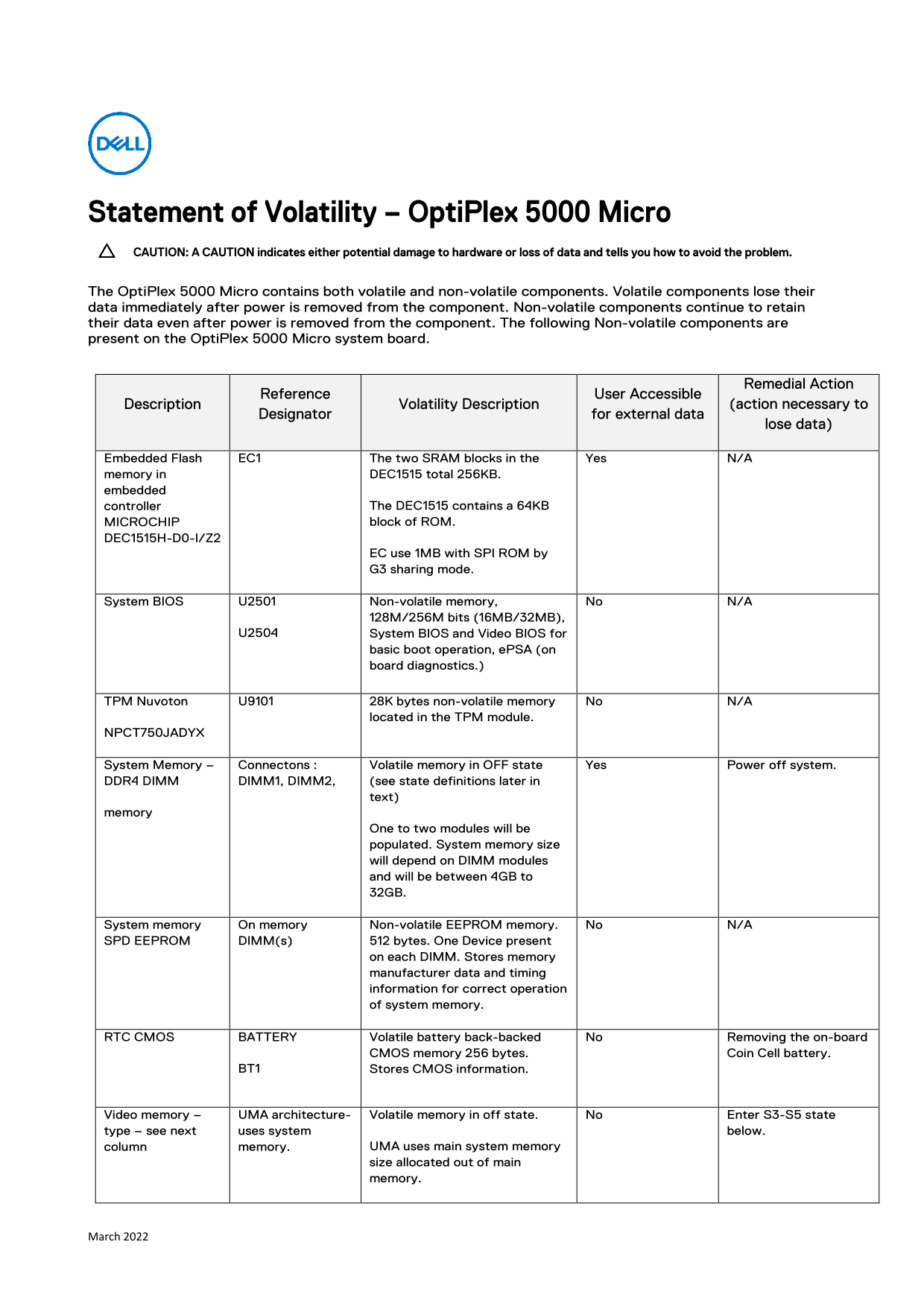
This is the Statement of Volatility for the Dell OptiPlex 5000 Micro desktop. The document certifies volatile and non-volatile memory components on the system board, including embedded controller flash (256KB SRAM, 1MB SPI ROM), system BIOS (16MB/32MB), TPM module (28K bytes), DDR4 DIMM memory (4GB to 32GB), SPD EEPROM (512 bytes per DIMM), RTC CMOS battery-backed memory (256 bytes), and UMA video memory. For each component, it specifies reference designator, volatility type, user accessibility, and remedial action. Target users are security professionals requiring volatility certification.
Page 1 Text Content
Statement of Volatility – Opti Plex 5000 Micro CAUTION: A CAUTION indicates either potential damage to hardware or loss of data and tells you how to avoid the problem. The Opti Plex 5000 Micro contains both volatile and non-volatile components. Volatile components lose their data immediately after power is removed from the component. Non-volatile components continue to retain their data even after power is removed from the component. The following Non-volatile components are present on the Opti Plex 5000 Micro system board.
Remedial Action
Reference User Accessible
Description Volatility Description (action necessary to
Designator for external data
lose data)
Embedded Flash EC1 The two SRAM blocks in the Yes N/A memory in DEC1515 total 256KB. embedded
controller The DEC1515 contains a 64KB MICROCHIP block of ROM.
DEC1515H-D0-I/Z2
EC use 1MB with SPI ROM by G3 sharing mode.
System BIOS U2501 Non-volatile memory, No N/A
128M/256M bits (16MB/32MB),
U2504 System BIOS and Video BIOS for
basic boot operation, e PSA (on board diagnostics.)
TPM Nuvoton U9101 28K bytes non-volatile memory No N/A
located in the TPM module.
NPCT750JADYX
System Memory – Connectons : Volatile memory in OFF state Yes Power off system. DDR4 DIMM DIMM1, DIMM2, (see state definitions later in
text)
memory
One to two modules will be populated. System memory size will depend on DIMM modules and will be between 4GB to 32GB.
System memory On memory Non-volatile EEPROM memory. No N/A SPD EEPROM DIMM(s) 512 bytes. One Device present
on each DIMM. Stores memory manufacturer data and timing information for correct operation of system memory.
RTC CMOS BATTERY Volatile battery back-backed No Removing the on-board
CMOS memory 256 bytes. Coin Cell battery.
BT1 Stores CMOS information.
Video memory – UMA architecture- Volatile memory in off state. No Enter S3-S5 state type – see next uses system below.
column memory. UMA uses main system memory size allocated out of main memory.
March 2022
Page Summary Contents For Dell OptiPlex 5000 Micro Statement of Volatility Owner's Manual
Manual Details
| Brand | Dell |
|---|---|
| Pages | 2 |
| File Size | 121.75 KB |
| Published | June 26, 2026 |
Enter the captcha to get the download link:

Frequently Asked Questions
What components lose data when power is removed?
Volatile components like DDR4 DIMM and the RTC CMOS battery will lose data immediately if power is removed.
How do I save system context in hibernate mode (S4)?
The OS writes the system context to a non-volatile storage file, which restores when returning to the working state.
What action prevents loss of time/configuration settings?
Removing the on-board coin cell battery (BT1) causes secondary power loss and will destroy configuration data.
Is the operating system's saved user context maintained in standby mode (S3)?
Yes, in S3 (suspend to RAM), the dynamic RAM is maintained, preserving the system context if supported by OS/peripherals.