Dell Genomics At A Glance-Part2 Overview/Quick Guide
Summary
This document provides an overview of next-generation sequencing (NGS) workflows, focusing on genomics applications. It covers sample preparation, sequencing by synthesis technology, data alignment, and downstream analysis for DNA-Seq and RNA-Seq studies. The manual explains the fundamental steps from sample extraction to data interpretation, including the roles of different NGS platforms and aligners. It is intended for researchers, bioinformaticians, and laboratory professionals working in genomics and molecular biology.
Page 1 Text Content
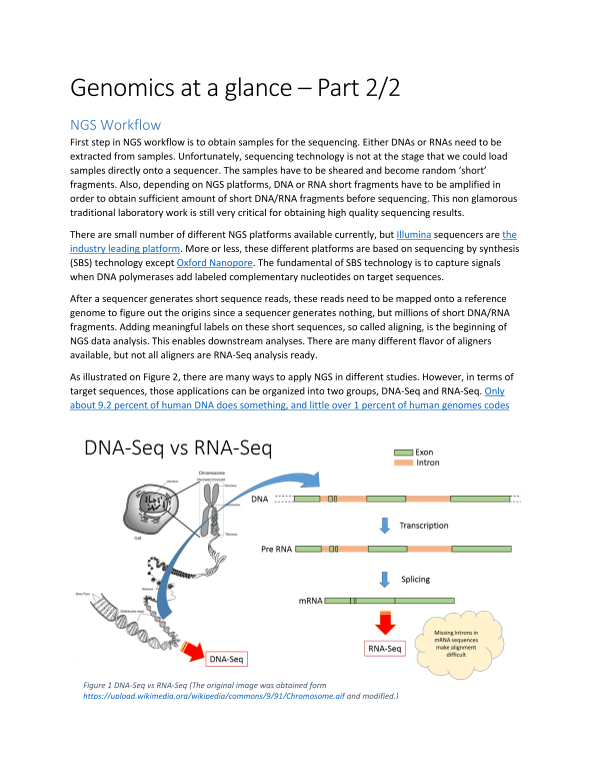
Genomics at a glance – Part 2/2 NGS Workflow First step in NGS workflow is to obtain samples for the sequencing. Either DNAs or RNAs need to be extracted from samples. Unfortunately, sequencing technology is not at the stage that we could load samples directly onto a sequencer. The samples have to be sheared and become random ‘short’ fragments. Also, depending on NGS platforms, DNA or RNA short fragments have to be amplified in order to obtain sufficient amount of short DNA/RNA fragments before sequencing. This non glamorous traditional laboratory work is still very critical for obtaining high quality sequencing results. There are small number of different NGS platforms available currently, but Illumina sequencers are the industry leading platform. More or less, these different platforms are based on sequencing by synthesis (SBS) technology except Oxford Nanopore. The fundamental of SBS technology is to capture signals when DNA polymerases add labeled complementary nucleotides on target sequences. After a sequencer generates short sequence reads, these reads need to be mapped onto a reference genome to figure out the origins since a sequencer generates nothing, but millions of short DNA/RNA fragments. Adding meaningful labels on these short sequences, so called aligning, is the beginning of NGS data analysis. This enables downstream analyses. There are many different flavor of aligners available, but not all aligners are RNA-Seq analysis ready. As illustrated on Figure 2, there are many ways to apply NGS in different studies. However, in terms of target sequences, those applications can be organized into two groups, DNA-Seq and RNA-Seq. Only about 9.2 percent of human DNA does something, and little over 1 percent of human genomes codes
Figure 1 DNA-Seq vs RNA-Seq (The original image was obtained form https://upload.wikimedia.org/wikipedia/commons/9/91/Chromosome.gif and modified.)
Page Summary Contents For Dell Genomics At A Glance-Part2 Overview/Quick Guide
Manual Details
| Brand | Dell |
|---|---|
| Pages | 3 |
| File Size | 594.72 KB |
| Published | June 20, 2026 |
Enter the captcha to get the download link:

Frequently Asked Questions
How does DNA-Seq differ from RNA-Seq?
DNA-Seq identifies gene locations and regulatory regions, while RNA-Seq analyzes gene expression levels and which genes are active at a given moment.
What is the first step in NGS workflow?
Obtain samples and extract either DNAs or RNAs, followed by shearing fragments and amplification.
Why is aligning sequence reads necessary?
Since sequencers generate random fragments without origin info, aligning maps reads onto a reference genome to determine gene locations.
What is library preparation?
It is the sample preparation process involving purifying genomic DNA, fragmenting it, adding adaptors, and amplifying via PCR.
What is a limitation of NGS?
Neither DNA-Seq nor RNA-Seq alone provides a complete answer, and results may vary due to experimental conditions or inherent technological errors.