Dell Eeny Meeny Miney Mo Should I Go with 20 Cores Owner's Manual
Summary
Performance analysis whitepaper comparing Intel Xeon E5-2600 v2 (Ivy Bridge) processor models for HPC workloads, examining core count trade-offs using 22nm process technology with increased clock rates and larger last-level cache versus Sandy Bridge and Westmere predecessors. Benchmarks six processor SKUs across real HPC applications in Dell engineering labs (December 2013), also evaluating single-rank versus dual-rank memory module performance and power consumption impact on cluster configurati
Page 1 Text Content
Eeny Meeny Miney Mo, should I go with 20 cores? Nishanth Dandapanthula, June 2014
Intel’s Xeon E5-2600 v2 product family processors (architecture code named Ivy Bridge) have been available in the server market for a few months now. Ivy bridge processor based systems provide better performance when compared to previous generation processor families such as Sandy Bridge (Xeon E5- 2600) and Westmere (Xeon X5600). This can be attributed to several factors, such as increased core counts because of the 22nm process technology, higher clock rates, increased system memory speeds and larger last level cache. This performance improvement is shown in several studies mentioned in 1, 2 and 3.
So, once the decision to move to a new platform or new processor technology has been made, what next? How should these new systems be configured? There are so many choices for the processor itself – different options with different core counts, processor frequency, TDP and, of course, price. Which processor model is optimal for a specific workload? This blog provides quantitative data and analysis to help answer this question by comparing the performance and power profile of different processor models across a variety of HPC applications.
Once the decision has been made to choose a particular processor SKU, there is another important decision which needs to be made. This is in regard to the choice between single rank and dual rank memory modules. As mentioned in studies 4 and 5, the choice and configuration of memory modules impacts the performance and power consumption statistics of an environment. This blog also describes a performance comparison done between single and dual rank memory modules for several HPC applications. These studies were done in the Dell engineering lab in December 2013 and results are actual measured results.
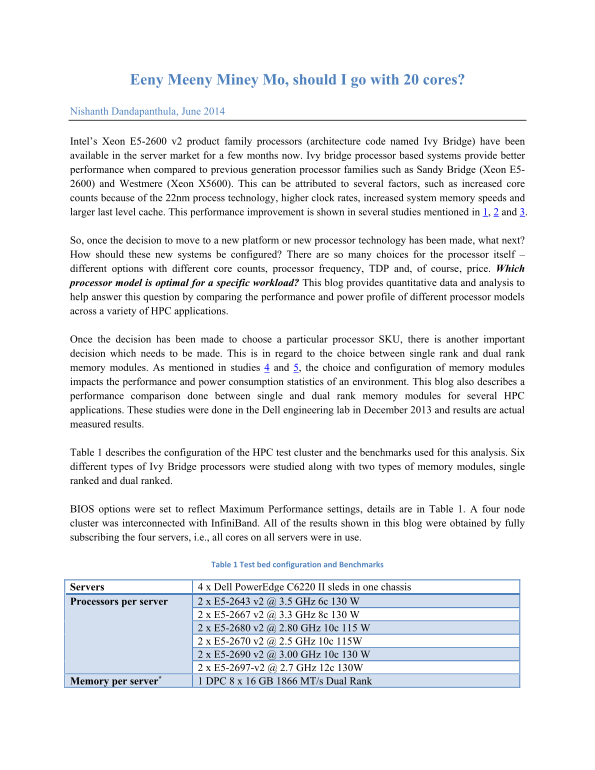
Table 1 describes the configuration of the HPC test cluster and the benchmarks used for this analysis. Six different types of Ivy Bridge processors were studied along with two types of memory modules, single ranked and dual ranked.
BIOS options were set to reflect Maximum Performance settings, details are in Table 1. A four node cluster was interconnected with Infini Band. All of the results shown in this blog were obtained by fully subscribing the four servers, i.e., all cores on all servers were in use.
Table 1 Test bed configuration and Benchmarks
Servers 4 x Dell Power Edge C6220 II sleds in one chassis Processors per server 2 x E5-2643 v2 @ 3.5 GHz 6c 130 W
2 x E5-2667 v2 @ 3.3 GHz 8c 130 W 2 x E5-2680 v2 @ 2.80 GHz 10c 115 W 2 x E5-2670 v2 @ 2.5 GHz 10c 115W 2 x E5-2690 v2 @ 3.00 GHz 10c 130 W 2 x E5-2697-v2 @ 2.7 GHz 12c 130W
Memory per server* 1 DPC 8 x 16 GB 1866 MT/s Dual Rank
Page Summary Contents For Dell Eeny Meeny Miney Mo Should I Go with 20 Cores Owner's Manual
Manual Details
| Brand | Dell |
|---|---|
| Pages | 7 |
| File Size | 718.79 KB |
| Published | June 15, 2026 |
Enter the captcha to get the download link:

Frequently Asked Questions
Does the choice of memory module matter for HPC applications?
Yes, choosing between single and dual rank memory modules impacts both performance and power consumption.
Which processor is best overall for most HPC benchmarks?
The E5-2697 v2 processor with dual rank DIMMs provides the best general performance for the evaluated HPC applications.
Should I prioritize high clock speed or core count for licensing cost apps?
If there is a per-core licensing fee, picking a processor with fewer cores but a higher clock speed (like E5-2643 v2) may be better than one with many cores but lower clock speed.
Is high memory bandwidth always the best choice?
No. For structural and fluid analysis like LS-DYNA, a processor with fewer cores can result in higher memory bandwidth per core when total bandwidth is fixed.