Danfoss Test Valve for Pressure Cartridge Transmitters, Type MBV 3000 Datasheet
Summary
This comprehensive guide details the MBV 3000 test valve, an essential tool designed for servicing Danfoss cartridge pressure transmitters in the marine sector. The manual covers technical specifications, installation procedures, and operational guidelines. Its primary advantage is enabling non-destructive testing of operating transmitters via a direct connection point and built-in shut-off valve, eliminating the need to drain the system. This product is ideal for instrumentation technicians and marine engineers requiring reliable, compact, and maintenance-friendly pressure monitoring solutions.
Page 1 Text Content
Data sheet
Test valve for pressure cartridge transmitters Type MBV 3000
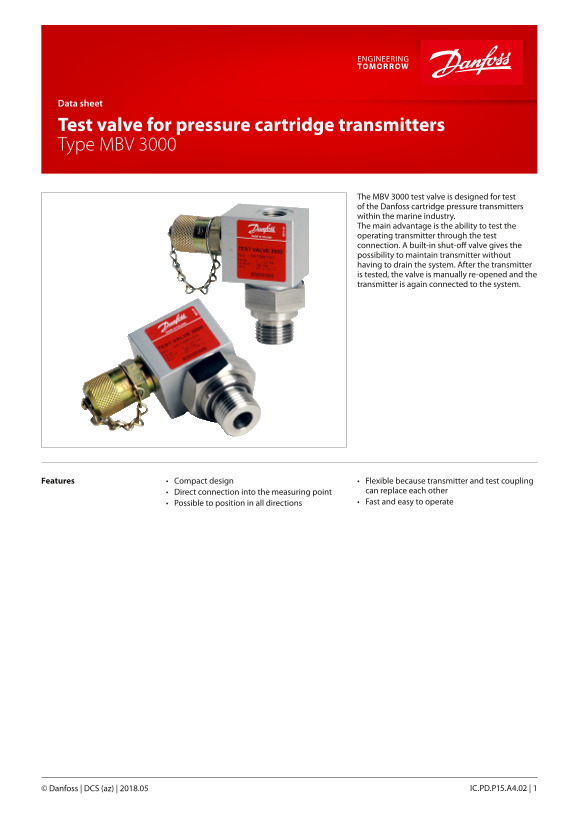
The MBV 3000 test valve is designed for test of the Danfoss cartridge pressure transmitters within the marine industry. The main advantage is the ability to test the operating transmitter through the test connection. A built-in shut-off valve gives the possibility to maintain transmitter without having to drain the system. After the transmitter is tested, the valve is manually re-opened and the transmitter is again connected to the system.
Features • Compact design • Flexible because transmitter and test coupling
• Direct connection into the measuring point can replace each other • Possible to position in all directions • Fast and easy to operate
© Danfoss | DCS (az) | 2018.05 IC.PD.P15.A4.02 | 1
Page Summary Contents For Danfoss Test Valve for Pressure Cartridge Transmitters, Type MBV 3000 Datasheet
Manual Details
| Brand | Danfoss |
|---|---|
| Pages | 3 |
| File Size | 721.77 KB |
| Published | June 06, 2026 |
Enter the captcha to get the download link:

Frequently Asked Questions
What is the operating pressure range for the MBV 3000 test valve?
The operating pressure ranges from 0 to 120 bar.
Does the MBV 3000 allow continuous system monitoring during testing?
Yes, a built-in shut-off valve allows maintenance of the transmitter without draining the system while testing.
What environmental conditions can the device withstand?
It operates under varying temperature ranges (-20 – 120 °C) and resists vibration/shock up to specified levels.
If used with sea water, what material must be selected for compatibility?
For sea water only, a stainless steel version should be used when selecting the appropriate components.