AKER 7 x 5 mm SMD Quartz Crystal Unit datasheet
Summary
Precision SMD quartz crystal unit optimized for stable oscillation at 14.7456 MHz. This comprehensive technical document provides engineers and electronics designers with all necessary specifications, including detailed electrical performance metrics, extended operating temperature ranges (-40°C to +85°C), mechanical diagrams, and adherence guidelines (RoHS Compliant). Ideal for building reliable timing circuits into demanding industrial applications requiring high stability and solder reflow compatibility.
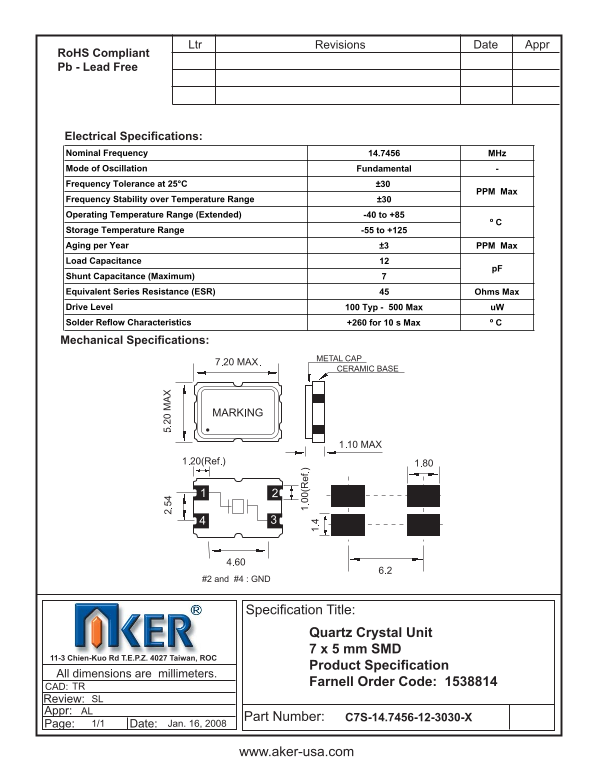
Page 1 Text Content
Revisions Ltr Date Appr
Ro HS Compliant Pb - Lead Free
Electrical Specifi cations: Nominal Frequency 14.7456 MHz Mode of Oscillation Fundamental Frequency Tolerance at 25°C ±30
PPM Max
Frequency Stability over Temperature Range ±30 Operating Temperature Range (Extended) -40 to +85
Storage Temperature Range -55 to +125 Aging per Year ±3 PPM Max Load Capacitance
Shunt Capacitance (Maximum) Equivalent Series Resistance (ESR) Ohms Max Drive Level 100 Typ - 500 Max u W Solder Reflow Characteristics +260 for 10 s Max º C
Mechanical Specifi cations:
Specifi cation Title:
Quartz Crystal Unit 7 x 5 mm SMD
11-3 Chien-Kuo Rd T.E.P.Z. 4027 Taiwan, ROC
Product Specifi cation
All dimensions are millimeters.
Farnell Order Code: 1538814TR
Review: SL
Appr: AL
Part Number: C7S-14.7456-12-3030-X
Page: 1/1 Date: Jan. 16, 2008
www.aker-usa.com
Page Summary Contents For AKER 7 x 5 mm SMD Quartz Crystal Unit datasheet
Manual Details
| Brand | Crystal |
|---|---|
| Pages | 1 |
| File Size | 56.63 KB |
| Published | May 18, 2026 |
Enter the captcha to get the download link:

Frequently Asked Questions
What is the operating temperature range for this crystal unit?
The operating temperature range is -40 to +85 °C.
Does this crystal meet environmental compliance standards?
Yes, it is RoHS Compliant and Lead Free.
What are the electrical specifications regarding frequency tolerance?
The fundamental frequency tolerance at 25°C is ±30 PPM.
How stable is the frequency over temperature changes?
The maximum frequency stability over the temperature range is ±30.