ABB Application Note - Laser Level Transmitters in Plastics Industry
Summary
Designed for maximizing efficiency in large industrial operations, this guide details the use of ABB laser level transmitters (LLT100) for precise inventory management of plastic pellets. Ideal for petrochemical and chemical manufacturers, these systems solve the challenges posed by narrow, tall storage silos where traditional measurement methods fail. The manual covers ideal installation practices, emphasizing the benefits of highly reliable, non-contact laser technology that provides accurate, low-maintenance level reporting crucial for automated supply chain solutions.
Page 1 Text Content
B M SU EM ENT & A LY TI S | PPLI ATI N NOTE
Easier, faster and less costly level measurement for the plastics industry
Plastic production and processing is one of the largest manufacturing industries. Laser transmitters have been successfully applied in this industry’s manufacturing, converting and recycling processes.
Measurement made easy
Storage silos for Overview
plastic pellets
The demand for plastic is growing as it is increasingly being used as a substitute for metals or
02 Narrow beam
other materials in the automotive, construction,
emitted by the LLT100
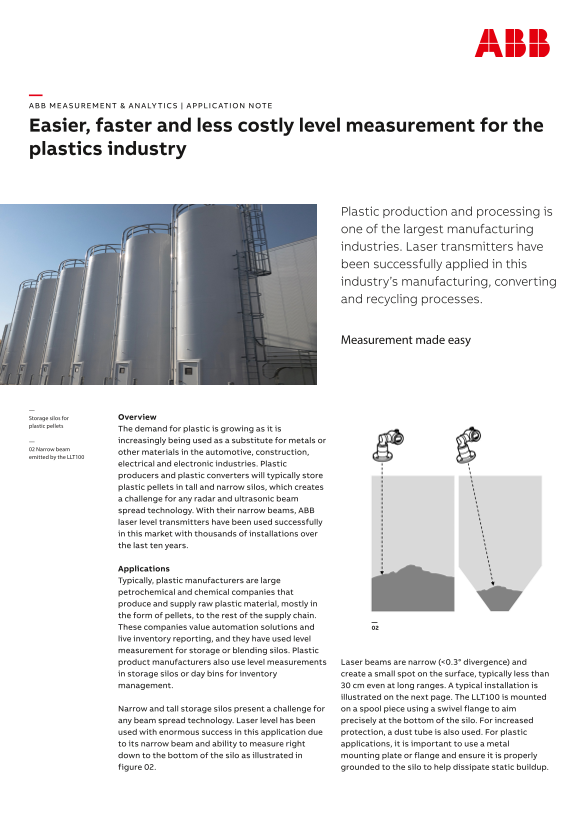
electrical and electronic industries. Plastic producers and plastic converters will typically store plastic pellets in tall and narrow silos, which creates a challenge for any radar and ultrasonic beam spread technology. With their narrow beams, ABB laser level transmitters have been used successfully in this market with thousands of installations over the last ten years.
Applications Typically, plastic manufacturers are large petrochemical and chemical companies that produce and supply raw plastic material, mostly in the form of pellets, to the rest of the supply chain. These companies value automation solutions and live inventory reporting, and they have used level measurement for storage or blending silos. Plastic product manufacturers also use level measurements Laser beams are narrow (<0.3° divergence) and in storage silos or day bins for inventory create a small spot on the surface, typically less than management. 30 cm even at long ranges. A typical installation is
illustrated on the next page. The LLT100 is mounted
Narrow and tall storage silos present a challenge for on a spool piece using a swivel flange to aim any beam spread technology. Laser level has been precisely at the bottom of the silo. For increased used with enormous success in this application due protection, a dust tube is also used. For plastic to its narrow beam and ability to measure right applications, it is important to use a metal down to the bottom of the silo as illustrated in mounting plate or flange and ensure it is properly figure 02. grounded to the silo to help dissipate static buildup.
Page Summary Contents For ABB Application Note - Laser Level Transmitters in Plastics Industry
Manual Details
| Brand | Laser |
|---|---|
| Pages | 2 |
| File Size | 976.64 KB |
| Published | June 03, 2026 |
Enter the captcha to get the download link:

Frequently Asked Questions
Why are laser level transmitters suitable for narrow and tall silos?
Their narrow beams (<0.3° divergence) create a small spot on the surface, allowing them to aim directly at the bottom of the silo.
What safety measures should be implemented when installing the LLT100?
Use a metal mounting plate or flange and ensure it is properly grounded to dissipate static buildup.
How does using lasers benefit maintenance compared to other technologies?
It is non-contact, meaning plastic pellets will not stick to the device and there are no moving parts leading to repetitive maintenance.
What types of environments work well with laser level technology for plastics industries?
The typical environment is stated as usually not dusty, which helps maintain clear laser beam reflection.