ABB Application Note - ATS430 Turbidity and TSS Optimize Your Water Discharge Quality Through Accurate Turbidity and Suspended Solids Measurement
Summary
Ensure optimal water clarity and meet strict discharge regulations with the ABB ATS430 system. This reliable continuous monitoring solution accurately measures both turbidity and Total Suspended Solids (TSS) in wastewater effluent. For municipal and industrial treatment facilities, it provides real-time data essential for maintaining operational compliance, assessing process efficiency, and protecting aquatic ecosystems from pollution. The compact, robust design is ideal wherever precise control of water quality indicators is critical.
Page 1 Text Content
B M SU EM ENT & A LY TI S | PPLI ATI N NOTE
ATS430 turbidity and TSS Optimize your water discharge quality through accurate turbidity and suspended solids measurement
Maintain regulatory compliance and eliminate measurement uncertainty using ABB turbidity and total suspended solids system.
Measurement made easy
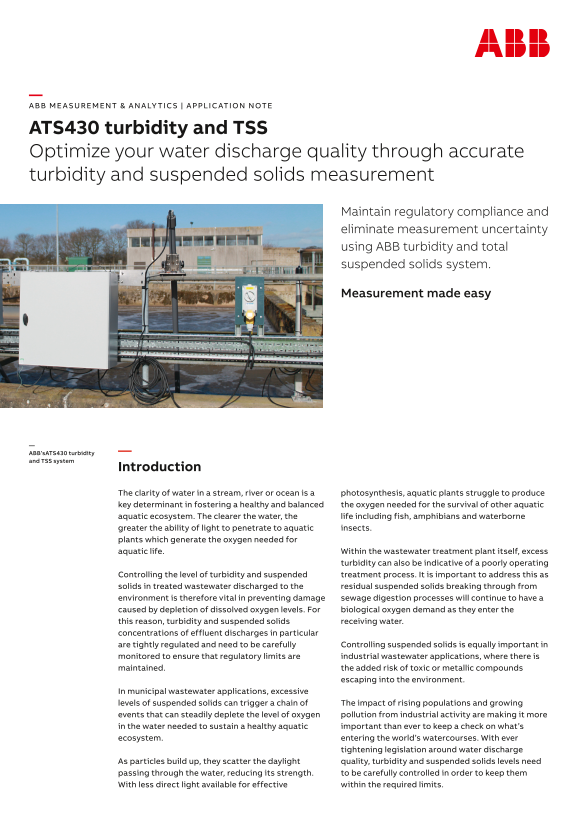
ABB’s ATS430 turbidity and TSS system
Introduction The clarity of water in a stream, river or ocean is a photosynthesis, aquatic plants struggle to produce key determinant in fostering a healthy and balanced the oxygen needed for the survival of other aquatic aquatic ecosystem. The clearer the water, the life including fish, amphibians and waterborne greater the ability of light to penetrate to aquatic insects. plants which generate the oxygen needed for aquatic life. Within the wastewater treatment plant itself, excess
turbidity can also be indicative of a poorly operating
Controlling the level of turbidity and suspended treatment process. It is important to address this as solids in treated wastewater discharged to the residual suspended solids breaking through from environment is therefore vital in preventing damage sewage digestion processes will continue to have a caused by depletion of dissolved oxygen levels. For biological oxygen demand as they enter the this reason, turbidity and suspended solids receiving water. concentrations of effluent discharges in particular are tightly regulated and need to be carefully Controlling suspended solids is equally important in monitored to ensure that regulatory limits are industrial wastewater applications, where there is maintained. the added risk of toxic or metallic compounds
escaping into the environment.
In municipal wastewater applications, excessive levels of suspended solids can trigger a chain of The impact of rising populations and growing events that can steadily deplete the level of oxygen pollution from industrial activity are making it more in the water needed to sustain a healthy aquatic important than ever to keep a check on what’s ecosystem. entering the world’s watercourses. With ever
tightening legislation around water discharge
As particles build up, they scatter the daylight quality, turbidity and suspended solids levels need passing through the water, reducing its strength. to be carefully controlled in order to keep them With less direct light available for effective within the required limits.
Page Summary Contents For ABB Application Note - ATS430 Turbidity and TSS Optimize Your Water Discharge Quality Through Accurate Turbidity and Suspended Solids Measurement
Manual Details
| Brand | Measurement |
|---|---|
| Pages | 8 |
| File Size | 4.53 MB |
| Published | June 05, 2026 |
Enter the captcha to get the download link:

Frequently Asked Questions
What primary measurements does the ATS430 system provide?
It provides an estimation of turbidity—water clarity—and Total Suspended Solids (TSS) in real time.
Does the instrument support various installation types?
Yes, it features a compact design with a range of mounting options and is suitable for wastewater discharge monitoring.
How complex is the sensor maintenance or servicing lifecycle?
The system supports easy calibration and promises no servicing requirement for the entire lifetime of the sensor.
Are there environmental factors affecting measurement accuracy apart from solids?
Yes, dissolved organic matter can absorb light instead of scattering it, which may affect the determination's accuracy.