ABB Application Description - pH ORP Measurement. Sugar Mill Liming Process Application Note
Summary
Master this complex sugar mill liming process with specialized pH and ORP measurement equipment. This manual details industrial solutions for reliable sensing within highly acidic and caustic refining environments. Ideal for sugar processing facilities, refiners, and chemical engineers, it provides crucial technical specifications for maintaining accurate process control, even in challenging conditions involving extreme temperature variations and chemical precipitation.
Page 1 Text Content
B M SU EM ENT & A LY TI S | PPLI ATI N DE SCR TI
p H/ORP measurement Sugar mill liming process
Measurement made easy
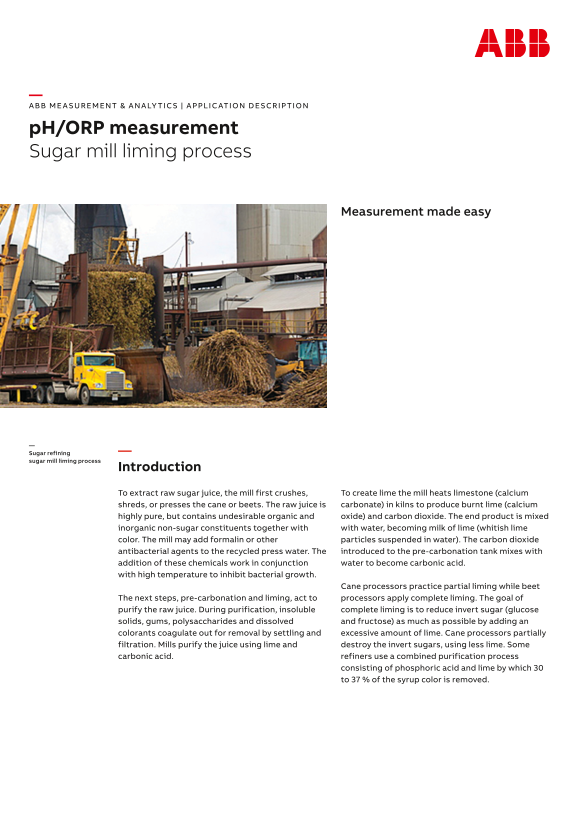
Sugar refining sugar mill liming process
Introduction To extract raw sugar juice, the mill first crushes, To create lime the mill heats limestone (calcium shreds, or presses the cane or beets. The raw juice is carbonate) in kilns to produce burnt lime (calcium highly pure, but contains undesirable organic and oxide) and carbon dioxide. The end product is mixed inorganic non-sugar constituents together with with water, becoming milk of lime (whitish lime color. The mill may add formalin or other particles suspended in water). The carbon dioxide antibacterial agents to the recycled press water. The introduced to the pre-carbonation tank mixes with addition of these chemicals work in conjunction water to become carbonic acid. with high temperature to inhibit bacterial growth.
Cane processors practice partial liming while beet
The next steps, pre-carbonation and liming, act to processors apply complete liming. The goal of purify the raw juice. During purification, insoluble complete liming is to reduce invert sugar (glucose solids, gums, polysaccharides and dissolved and fructose) as much as possible by adding an colorants coagulate out for removal by settling and excessive amount of lime. Cane processors partially filtration. Mills purify the juice using lime and destroy the invert sugars, using less lime. Some carbonic acid. refiners use a combined purification process
consisting of phosphoric acid and lime by which 30 to 37 % of the syrup color is removed.
Page Summary Contents For ABB Application Description - pH ORP Measurement. Sugar Mill Liming Process Application Note
Manual Details
| Brand | Measurement |
|---|---|
| Pages | 4 |
| File Size | 1.34 MB |
| Published | June 03, 2026 |
Enter the captcha to get the download link:

Frequently Asked Questions
What sensor technology is recommended for direct insertion into highly corrosive sugar refining applications?
For directly inserted processes, ABB recommends a retractable sensor with an extraction housing.
Which ABB sensors are best suited for measuring pH in the harsh environments of lime treatment?
The TBX587 and TBX551 models are good, retrievable sensors proven to tolerate these aggressive industrial conditions.
How does using a retractable sensor simplify maintenance at the site?
The bayonet-style mounting feature on some sensors makes removal for cleaning and calibration easier for onsite staff.