PHILIPS BB155 Low-voltage Variable Capacitance Diode Data Sheet
Summary
This datasheet provides specifications for the Philips BB155 low-voltage variable capacitance diode in a SOD323 ultra-small SMD plastic package, featuring very low capacitance spread and excellent linearity. It details electrical characteristics including capacitance versus reverse voltage curves, series resistance, and application guidance for voltage-controlled oscillators in mobile communication equipment.
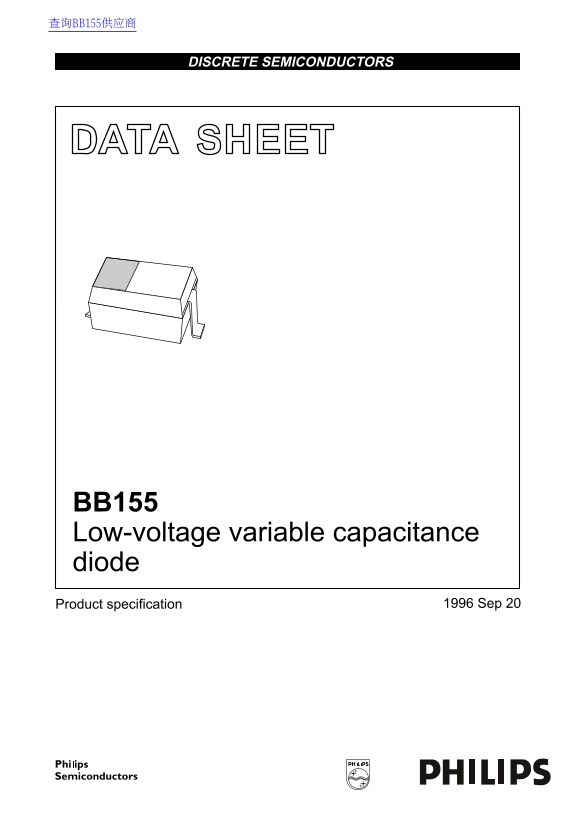
Page 1 Text Content
查询BB155供应商
DISCRETE SEMICONDUCTORS
DATA SHEET
alfpage
BB155 Low-voltage variable capacitance diode
Product specification Sep
Page Summary Contents For PHILIPS BB155 Low-voltage Variable Capacitance Diode Data Sheet
Manual Details
| Brand | Philips |
|---|---|
| Pages | 4 |
| File Size | 30.31 KB |
| Published | June 17, 2026 |
Enter the captcha to get the download link:

Frequently Asked Questions
What is the physical package type for the BB155 diode?
It comes in a very small plastic SMD SOD323 package.
How can I locate the cathode side of the component?
The marking bar indicates the cathode side (VCO).
What are the operating temperature guidelines for this device?
The junction temperature must operate between -55°C and +125°C, with a storage range of -55°C to +150°C.
Are there restrictions regarding life support applications?
No, these products are not designed for use in life support appliances or systems.