Intel White Paper Programmable Platform Solution
Summary
Unlock rapid, low-cost product innovation with Programmable Logic Devices (PLDs). This guide details how PLD-based platforms enable "design once, make many" development strategies by providing unparalleled flexibility over fixed hardware solutions. It covers mitigating lifecycle challenges—from concept prototyping to product upgrading in mature markets—allowing for easy feature differentiation across various industries. Perfect for engineers and companies needing a scalable foundation to rapidly enter new markets, adapt to feedback, and maintain a competitive edge without costly silicon redesigns.
Page 1 Text Content
White Paper
Programmable Platform Solutions
Introduction When new generations of products are introduced as often as every quarter, designers require a product development strategy that is flexible, fast, and low cost. A PLD-based programmable platform can provide a foundation for rapid, low-cost product innovation and evolution. This platform can help designers react in real time to customer feedback and market changes; tailor features of a basic design for different users, regions, or price points; develop differentiated features before the competition; and maintain the first-mover advantage that is so critical to market success. This “design once, make many” approach improves productivity, saves development time, and ultimately saves money.
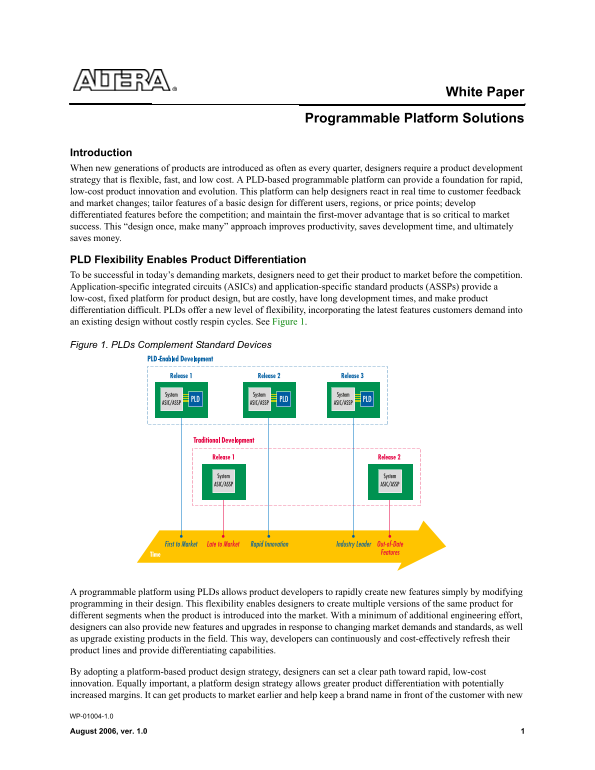
PLD Flexibility Enables Product Differentiation To be successful in today’s demanding markets, designers need to get their product to market before the competition. Application-specific integrated circuits (ASICs) and application-specific standard products (ASSPs) provide a low-cost, fixed platform for product design, but are costly, have long development times, and make product differentiation difficult. PLDs offer a new level of flexibility, incorporating the latest features customers demand into an existing design without costly respin cycles. See Figure 1.
Figure 1. PLDs Complement Standard Devices
A programmable platform using PLDs allows product developers to rapidly create new features simply by modifying programming in their design. This flexibility enables designers to create multiple versions of the same product for different segments when the product is introduced into the market. With a minimum of additional engineering effort, designers can also provide new features and upgrades in response to changing market demands and standards, as well as upgrade existing products in the field. This way, developers can continuously and cost-effectively refresh their product lines and provide differentiating capabilities.
By adopting a platform-based product design strategy, designers can set a clear path toward rapid, low-cost innovation. Equally important, a platform design strategy allows greater product differentiation with potentially increased margins. It can get products to market earlier and help keep a brand name in front of the customer with new
WP-01004-1.0
August 2006, ver. 1.0
Page Summary Contents For Intel White Paper Programmable Platform Solution
Manual Details
| Brand | Intel |
|---|---|
| Pages | 5 |
| File Size | 756.28 KB |
| Published | June 03, 2026 |
Enter the captcha to get the download link:

Frequently Asked Questions
How does using PLDs help with product differentiation?
PLDs offer flexibility to incorporate new features into an existing design without costly respin cycles, allowing multiple versions of the same product for different segments.
At what stage of the product life cycle can a PLD-based strategy be used?
It can address challenges at concept, emerging market, aggressive growth, and mature market stages.
What is the primary benefit of designing with a programmable electronic platform?
This "design once, make many" approach improves productivity, saves development time, and ultimately saves money by allowing rapid, low-cost innovation.