Intel White Paper on Generating Panoramic Views by Stitching Multiple Fisheye Images
Summary
Advanced documentation detailing an innovative architectural approach developed by Altera and Manipal Dot Net. The paper explains how to generate comprehensive 360° panoramic views by accurately stitching multiple fisheye images onto an FPGA platform. It is essential reading for engineers, automotive developers, and computer vision specialists interested in creating highly functional, wide-angle imaging systems for vehicle navigation and surveillance.
Page 1 Text Content
White Paper
Generating Panoramic Views by Stitching Multiple Fisheye Images
This white paper discusses an innovative architecture developed by Altera and Manipal Dot Net to generate panoramic views by stitching multiple fisheye images on an FPGA. This architecture provides a complete view of a vehicle’s surroundings to the driver and makes it easier to control and navigate the vehicle.
Introduction Fisheye cameras are finding an increasing number of applications in automobile imaging systems due to their ultra-wide-angle properties and cost-effectiveness. One such application renders a display of the 360° scene around the vehicle, which is achieved by stitching together multiple images that are captured by an array of fisheye cameras. This provides a complete panoramic view of the vehicle’s surroundings to the driver and makes it easier to control and navigate the vehicle.
Since fisheye lenses(1) have very large wide-angle views, fewer cameras are needed to generate a panoramic view. However, fisheye images suffer from severe distortion due to the frontal hemispheric scene being mapped onto a flat surface. Because of this distortion, the stitching of multiple fisheye images is a non-trivial task and involves intensive computations and image processing. In general, the problem is difficult to solve, and therefore requires certain simplifying assumptions and approximations to make it feasible. The application assumes that the objects in the scene to be stitched are sufficiently far away from the camera, so that stereographic disparity is negligible.
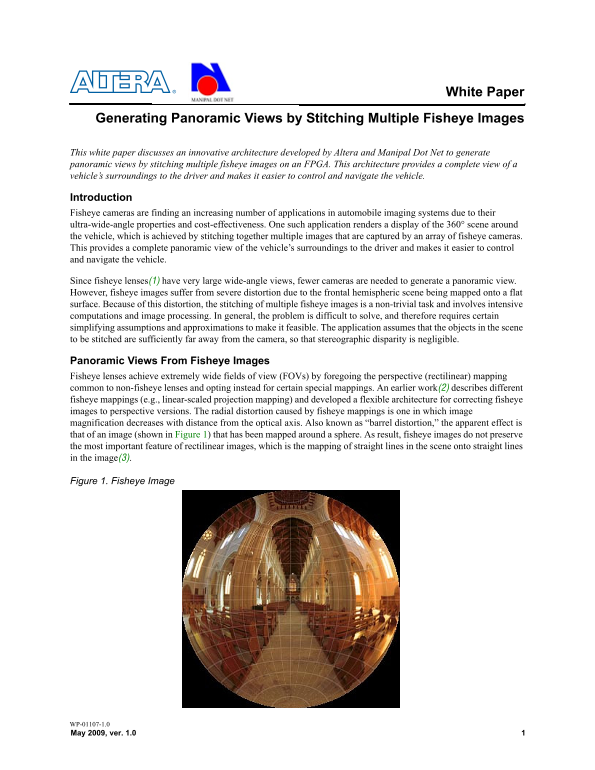
Panoramic Views From Fisheye Images Fisheye lenses achieve extremely wide fields of view (FOVs) by foregoing the perspective (rectilinear) mapping common to non-fisheye lenses and opting instead for certain special mappings. An earlier work(2) describes different fisheye mappings (e.g., linear-scaled projection mapping) and developed a flexible architecture for correcting fisheye images to perspective versions. The radial distortion caused by fisheye mappings is one in which image magnification decreases with distance from the optical axis. Also known as “barrel distortion,” the apparent effect is that of an image (shown in Figure 1) that has been mapped around a sphere. As result, fisheye images do not preserve the most important feature of rectilinear images, which is the mapping of straight lines in the scene onto straight lines in the image(3).
Figure 1. Fisheye Image
WP-01107-1.0 May 2009, ver. 1.0
Page Summary Contents For Intel White Paper on Generating Panoramic Views by Stitching Multiple Fisheye Images
Manual Details
| Brand | Intel |
|---|---|
| Pages | 9 |
| File Size | 778.80 KB |
| Published | June 05, 2026 |
Enter the captcha to get the download link:

Frequently Asked Questions
What is the primary application for stitching multiple fisheye images?
To generate a complete 360° panoramic view of a vehicle’s surroundings, assisting the driver with control and navigation.
Why is generating a panoramic view from fisheye images complicated?
Fisheye images suffer from severe distortion because the frontal hemispheric scene must be mapped onto a flat surface, requiring intensive computation.
What unique correction property must be applied when stitching these images?
The special correction must ensure little or no perspective distortion in the horizontal direction while allowing for vertical perspective distortion.