Honeywell FSS Series Low Profile Force Sensors Product Documentation
Summary
The FSS Series Low Profile Force Sensor provides highly precise, reliable measurement of force using specialized piezoresistive technology within a compact, commercial-grade package. This low-power sensor utilizes modular design and inherently stable outputs, making it ideal for critical applications. The manual details performance specifications, operational principles, and variable coupling options suitable for major industries. It is primarily used in medical equipment (e.g., infusion pumps, dialysis machines) and industrial fields requiring sensitive measurement, such as load sensing and robotic end-effectors.
Page 1 Text Content
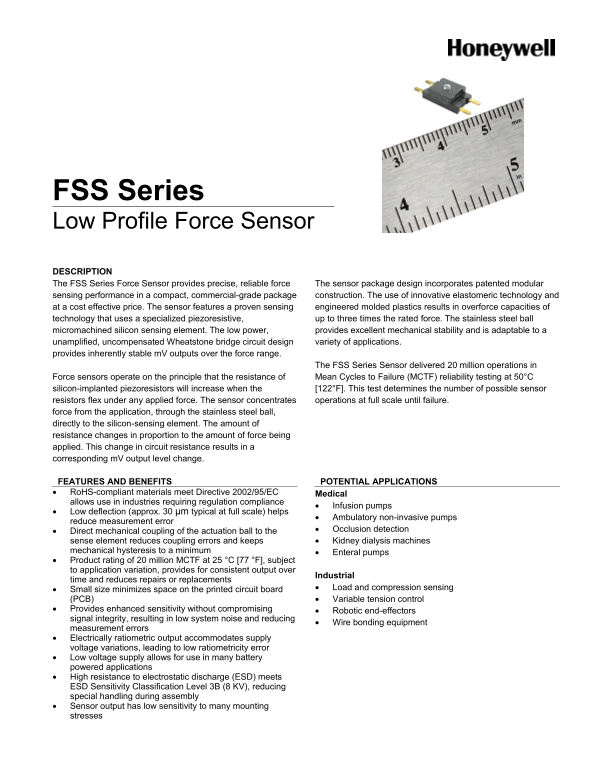
FSS Series Low Profile Force Sensor DESCRIPTION The FSS Series Force Sensor provides precise, reliable force The sensor package design incorporates patented modular sensing performance in a compact, commercial-grade package construction. The use of innovative elastomeric technology and at a cost effective price. The sensor features a proven sensing engineered molded plastics results in overforce capacities of technology that uses a specialized piezoresistive, up to three times the rated force. The stainless steel ball micromachined silicon sensing element. The low power, provides excellent mechanical stability and is adaptable to a unamplified, uncompensated Wheatstone bridge circuit design variety of applications. provides inherently stable m V outputs over the force range.
The FSS Series Sensor delivered 20 million operations in
Force sensors operate on the principle that the resistance of Mean Cycles to Failure (MCTF) reliability testing at 50°C silicon-implanted piezoresistors will increase when the [122°F]. This test determines the number of possible sensor resistors flex under any applied force. The sensor concentrates operations at full scale until failure. force from the application, through the stainless steel ball, directly to the silicon-sensing element. The amount of resistance changes in proportion to the amount of force being applied. This change in circuit resistance results in a corresponding m V output level change.
FEATURES AND BENEFITS POTENTIAL APPLICATIONS Ro HS-compliant materials meet Directive 2002/95/EC Medical allows use in industries requiring regulation compliance
Infusion pumps
Low deflection (approx. 30 µm typical at full scale) helps
Ambulatory non-invasive pumps
reduce measurement error
Direct mechanical coupling of the actuation ball to the Occlusion detection
sense element reduces coupling errors and keeps Kidney dialysis machines mechanical hysteresis to a minimum Enteral pumps Product rating of 20 million MCTF at 25 °C [77 °F], subject to application variation, provides for consistent output over
Industrial
time and reduces repairs or replacements
Small size minimizes space on the printed circuit board Load and compression sensing
(PCB) Variable tension control Provides enhanced sensitivity without compromising Robotic end-effectors signal integrity, resulting in low system noise and reducing
Wire bonding equipment
measurement errors Electrically ratiometric output accommodates supply voltage variations, leading to low ratiometricity error Low voltage supply allows for use in many battery powered applications High resistance to electrostatic discharge (ESD) meets ESD Sensitivity Classification Level 3B (8 KV), reducing special handling during assembly Sensor output has low sensitivity to many mounting stresses
Page Summary Contents For Honeywell FSS Series Low Profile Force Sensors Product Documentation
Manual Details
| Brand | Honeywell |
|---|---|
| Pages | 4 |
| File Size | 346.80 KB |
| Published | June 05, 2026 |
Enter the captcha to get the download link:

Frequently Asked Questions
How is the output signal generated by the sensor?
The resistance of the silicon-implanted piezoresistors changes in proportion to applied force, resulting in a corresponding voltage (mV) output.
What kind of applications use this sensor due to regulatory compliance?
It uses RoHS-compliant materials, making it suitable for regulated medical areas like infusion pumps and kidney dialysis machines.
How reliable is the product over time?
The FSS Series has a stated Mean Cycles to Failure (MCTF) rating of 20 million cycles at 25 °C [77 °F].
What should I be aware of when temperature changes occur?
Temperature variation causes the null shift, which is an unpredicted error that shifts the entire output curve up or down along the voltage axis.