Fuji Electric Instrumentation and Measurement Series FKP...5 Pressure Transmitter (Direct Mount Type) Product Specifications Sheet
Summary
The FCX–AIII Pressure Transmitter offers highly accurate gauge pressure measurement via a proportional 4–20mA signal, utilizing unique micromachined capacitive silicon technology for superior performance. This manual details comprehensive specifications, including model versatility across various ranges and advanced features like the Advance Floating Cell design and bilingual Fuji/HART communication protocols. It is engineered for industrial process control applications requiring reliable monitoring of pressure in liquids, gases, or vapors across challenging environmental conditions.
Page 1 Text Content
PRESSURE TRANSMITTER (DIRECT MOUNT TYPE)
DATA SHEET FKP...5
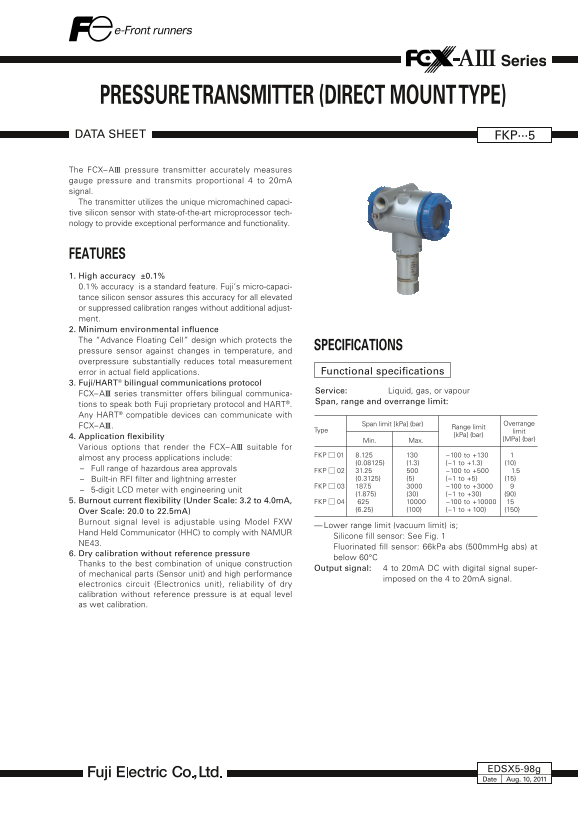
The FCX–AIII pressure transmitter accurately measures gauge pressure and transmits proportional 4 to 20m A signal. The transmitter utilizes the unique micromachined capaci- tive silicon sensor with state-of-the-art microprocessor tech- nology to provide exceptional performance and functionality.
FEATURES 1. High accuracy ±0.1% 0.1% accuracy is a standard feature. Fuji’s micro-capaci- tance silicon sensor assures this accuracy for all elevated or suppressed calibration ranges without additional adjust- ment. 2. Minimum environmental infl uence The “Advance Floating Cell” design which protects the
SPECIFICATIONS
pressure sensor against changes in temperature, and overpressure substantially reduces total measurement
error in actual fi eld applications. Functional specifi cations
3. Fuji/HART® bilingual communications protocol
Service: Liquid, gas, or vapour
FCX–AIII series transmitter offers bilingual communica-
Span, range and overrange limit:
tions to speak both Fuji proprietary protocol and HART®. Any HART® compatible devices can communicate with
Span limit [k Pa] {bar} Overrange
FCX–AIII. Range limit
Type limit
[k Pa] {bar}
4. Application fl exibility
Min. Max. [MPa] {bar}
Various options that render the FCX–AIII suitable for
FKP□ 8.125 −100 to + 130
almost any process applications include:
{0.08125} {1.3} {−1 to +1.3} {10}
– Full range of hazardous area approvals FKP□ 31.25 −100 to + 500 1.5
– Built-in RFI fi lter and lightning arrester {0.3125} {5} {−1 to +5} {15}
FKP□ 187.5 −100 to + 3000
– 5-digit LCD meter with engineering unit
{1.875} {30} {−1 to +30} {90}
5. Burnout current fl exibility (Under Scale: 3.2 to 4.0m A, FKP□ −100 to +10000
{6.25} {100} {−1 to + 100} {150}
Over Scale: 20.0 to 22.5m A) Burnout signal level is adjustable using Model FXW
— Lower range limit (vacuum limit) is;
Hand Held Communicator (HHC) to comply with NAMUR
Silicone fi ll sensor: See Fig. 1
NE43.
Fluorinated fi ll sensor: 66k Pa abs (500mm Hg abs) at
6. Dry calibration without reference pressure
below 60°C
Thanks to the best combination of unique construction
Output signal: 4 to 20m A DC with digital signal super-
of mechanical parts (Sensor unit) and high performance
imposed on the 4 to 20m A signal.
electronics circuit (Electronics unit), reliability of dry calibration without reference pressure is at equal level as wet calibration.
EDSX5-98g Aug. 10, 2011Date
Page Summary Contents For Fuji Electric Instrumentation and Measurement Series FKP...5 Pressure Transmitter (Direct Mount Type) Product Specifications Sheet
Manual Details
| Brand | Measurement |
|---|---|
| Pages | 8 |
| File Size | 181.84 KB |
| Published | May 29, 2026 |
Enter the captcha to get the download link:

Frequently Asked Questions
What measurement technology ensures high accuracy?
It utilizes a unique micromachined capacitive silicon sensor that provides an accuracy of ±0.1%.
Does the transmitter support multiple communication protocols?
Yes, it offers Fuji/HART bilingual communications protocol compatibility.
How can I adjust settings like zero or span?
Zero and span can be adjustable either externally via a Hand Held Communicator (HHC) or locally from the adjustment screw.
What is the operational temperature range for the unit?
The ambient temperature limit is generally -40 to +85°C, but specific components have differing limits.