Dell Precision T7600 Statement of Volatility
Summary
Statement of Volatility for Dell Precision Workstation T7600. Details volatile and non-volatile memory components including BIOS flash, embedded controller, PCH CMOS, Ethernet firmware, and hard drive cache. Specifies data retention after power removal and security implications for passwords and encryption keys. Target users are security professionals and organizations requiring secure disposal compliance.
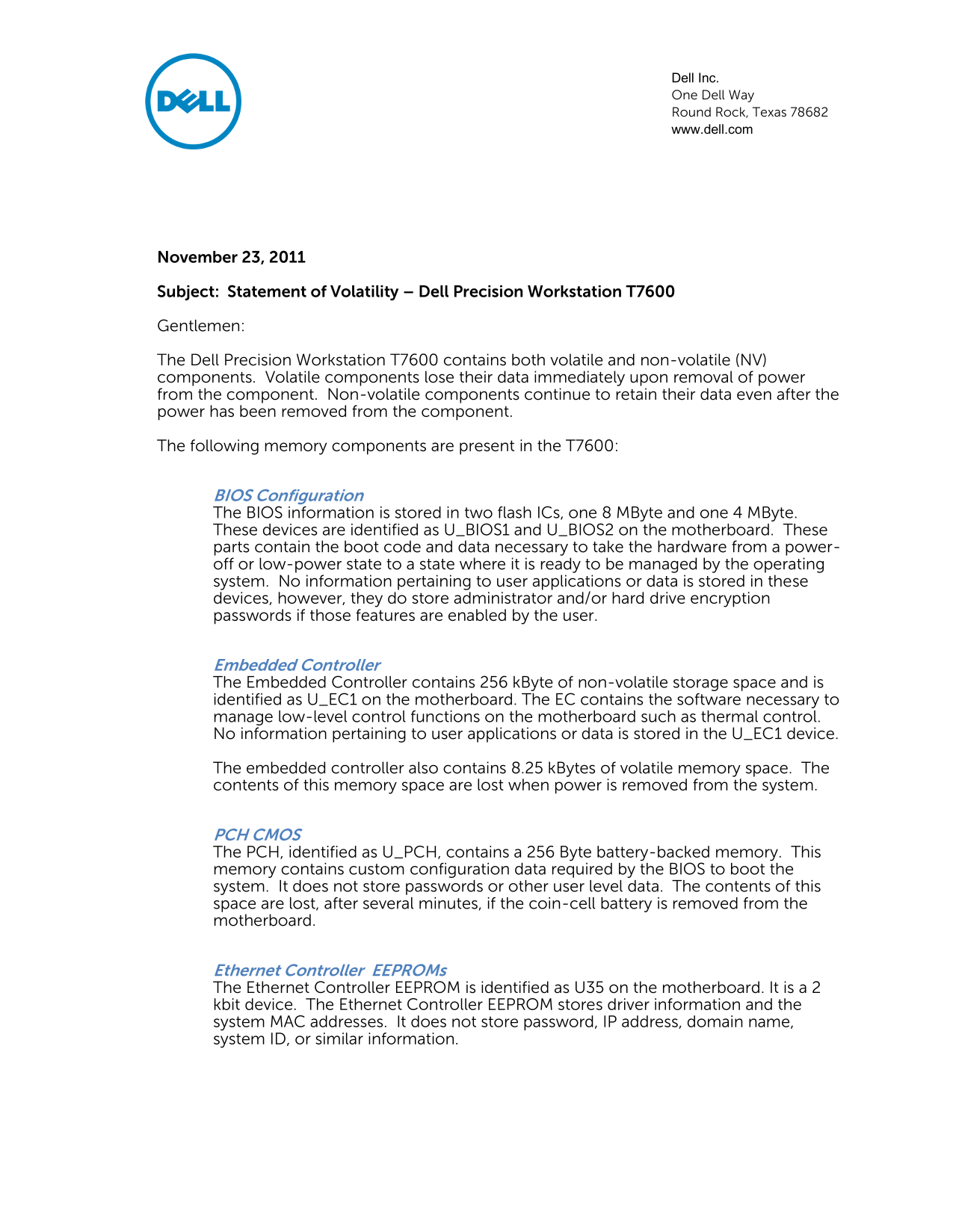
Page 1 Text Content
Dell Inc. One Dell Way Round Rock, Texas 78682 www.dell.com
November 23, 2011
Subject: Statement of Volatility – Dell Precision Workstation T7600
Gentlemen:
The Dell Precision Workstation T7600 contains both volatile and non-volatile (NV) components. Volatile components lose their data immediately upon removal of power from the component. Non-volatile components continue to retain their data even after the power has been removed from the component.
The following memory components are present in the T7600:
BIOS Configuration The BIOS information is stored in two flash ICs, one 8 MByte and one 4 MByte. These devices are identified as U_BIOS1 and U_BIOS2 on the motherboard. These parts contain the boot code and data necessary to take the hardware from a power- off or low-power state to a state where it is ready to be managed by the operating system. No information pertaining to user applications or data is stored in these devices, however, they do store administrator and/or hard drive encryption passwords if those features are enabled by the user.
Embedded Controller The Embedded Controller contains 256 k Byte of non-volatile storage space and is identified as U_EC1 on the motherboard. The EC contains the software necessary to manage low-level control functions on the motherboard such as thermal control. No information pertaining to user applications or data is stored in the U_EC1 device.
The embedded controller also contains 8.25 k Bytes of volatile memory space. The contents of this memory space are lost when power is removed from the system.
PCH CMOS The PCH, identified as U_PCH, contains a 256 Byte battery-backed memory. This memory contains custom configuration data required by the BIOS to boot the system. It does not store passwords or other user level data. The contents of this space are lost, after several minutes, if the coin-cell battery is removed from the motherboard.
Ethernet Controller EEPROMs The Ethernet Controller EEPROM is identified as U35 on the motherboard. It is a 2 kbit device. The Ethernet Controller EEPROM stores driver information and the system MAC addresses. It does not store password, IP address, domain name, system ID, or similar information.
Page Summary Contents For Dell Precision T7600 Statement of Volatility
Manual Details
| Brand | Dell |
|---|---|
| Pages | 3 |
| File Size | 97.82 KB |
| Published | June 29, 2026 |
Enter the captcha to get the download link:

Frequently Asked Questions
What types of memory components are volatile or non-volatile?
Volatile components lose data immediately when power is removed, while non-volatile components retain data.
How can I retrieve the system context in different power states?
S3 (Suspend to RAM) maintains dynamic RAM. S4 (Hibernate) saves system context to a non-volatile storage file.
Which data stored on the T7600 is sensitive or related to user passwords?
The BIOS stores administrator and/or hard drive encryption passwords, which are necessary for device security.
What happens to data when I unplug the power cord (primary power loss)?
Primary power loss will destroy all user data in main system memory (DDR3 DIMMs) and on-board graphics/storage interface devices.