Page 1
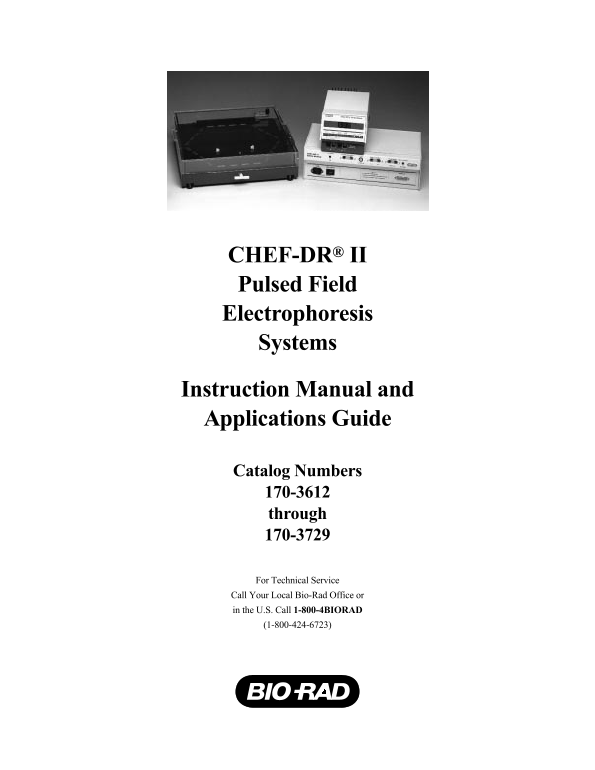
CHEF-DR® II Pulsed Field Electrophoresis Systems Instruction Manual and Applications Guide Catalog Numbers 170-3612 through 170-3729 For Technical Service Call Your Local Bio-Rad Office or in the U.S....
Page 2
Warranty The CHEF-DR II control module, drive module, chamber, variable speed pump, and accessories are warranted against defects in materials and workmanship for 1 year. If any defects occur in the i...
Page 3
Table of Contents Section 1 Introduction ..................................................................................................1 1.1 Safety ...................................................
Page 4
Section 1 General Information 1.1 Safety The CHEF-DR II system uses high voltage and current and should be operated with care at all times. The safety interlocks are for your protection and should not...
Page 5
1.3 Specifications These specifications pertain to the complete CHEF-DR II system. A system including the Model 1000 Mini Chiller is also available. CHEF-DR II Specifications Drive Module Dimensions 2...
Page 6
Accessories included Variable speed pump 120 V, ground isolated. Flow rate 0.75 liter/min, typical Casting stand 14 cm x 13 cm Comb 10 well comb and comb holder Tygon tubing 365 cm Sample plug mold 10...
Page 7
Figure 1.1 A shows the relative potentials of each electrode pair when the + 60° vector (indicated by the arrow) is activated. Net field vector is from NW to SE. The highest poten- tials are found alo...
Page 8
and high voltage to the electrophoresis cell is disrupted. The lid also contains a mount at the upper right for an external temperature probe, which monitors buffer temperature in the cham- ber, and r...
Page 9
Model 1000 Mini Chiller The Model 1000 Mini Chiller is a stand alone, portable refrigerated apparatus specifi- cally designed for use with the CHEF-DR II system. Electrophoresis buffer is circulated b...
Page 10
Connect the set of black and red cables from the left set of jacks on the control module labeled POWER SUPPLY (- and +) to the left set of jacks on the drive module labeled FROM POWER SUPPLY. Connect ...
Page 11
2.3 CHEF-DR II Operation This section describes general operation. See Sections 3 and 4 for sample preparation, gel casting, gel running, and staining. In the following sections capitalized words refe...
Page 12
Block Adjust from 1-2 Blocks. Block 1 is run first, then Block 2. A run time of 0 will disable a Block. Initial Sw. Time Press BLOCK and VOLTS/CM simultaneously. Adjust from 0.1 second-65,000 seconds ...
Page 13
Volts/cm This will display the set voltage gradient for 3 seconds after which the remaining time for the current Block in progress will be displayed. Actual Current This will display the actual curren...
Page 14
Section 3 Sample Preparation 3.1 Agarose Blocks Standard procedures for DNA preparation do not yield intact, high molecular weight DNA molecules. Large DNA molecules (chromosome-sized) are so fragile ...
Page 15
4. Combine the cell suspension with an equal volume of 2% Clean Cut agarose and mix gen- tly but thoroughly. Keeping the cell/agarose mixture at 50 °C, transfer the mixture to plug molds using sterile...
Page 16
5. Remove 5 x 10⁸ cells for each ml of agarose plugs to be made. Centrifuge for three min- utes in a microcentrifuge. If the volume is too large, spin at 10,000 x g for 5 minutes at 4 °C in an appropr...
Page 17
3.5 Preparation of Agarose Embedded Yeast DNA The buffers, enzymes, and agarose found in the following procedure are provided in the CHEF Yeast Genomic DNA Plug Kit (catalog number 170-3593; see Secti...
Page 18
12. Maintain the plugs in 1x Wash Buffer for long term storage. However , for subsequent restriction digestion, the EDTA concentration must be lowered. Wash the plugs to be restricted for 30 minutes i...
Page 19
3.8 Hemocytometer Usage A hemocytometer is usually divided into nine large squares (Figure 3.1). Each large square is 1 x 10⁻⁴ cm2 or 0.1 mm3, one such square (A) is shown in the figure with darkened ...
Page 20
B. Bacteria and Yeast Cells: Count five to ten of the 25 center squares, at 400x power, to get a representative sample of your cell suspension. You should have approximately 25 to 75 cells per square....
Page 21
Example Calculations: Mammalian: (A) (6 x 10⁹ bp)(660 g/mole) = 6.547 x 10⁻¹² g DNA/cell 6.02 x 10²³ bp/mole (B) (6.578 x 10⁻¹² g/cell)(5 x 107 cells/ml) = (3.289 x 10⁻⁴ g DNA/ml)(1x106 µg/g) - 329 mg...
Page 22
Yeast: (A) (1.5 x 10⁷ bp)(660 g/mole) = 1.644 x 10⁻¹⁴ g DNA/cell 6.02 x 10²³ bp/mole (B) (1.644 x 10⁻¹⁴ g DNA/cell)(6 x 108 cells/ml) = (9.876 x 10⁻⁶ g DNA/ml)(1x106 µg/g) = 9.876 µg DNA/ml (C) (9.876...
Page 23
4. Place the comb holder (with attached comb) into one of the two positioning slots on each side of the casting stand. Check that the bottom of the comb is at least 2 mm above the sur- face of the pla...
Page 24
Buffer Voltage Current Concentration Gradient Range 0.5x TBE (at 14 ˚C) 2 V/cm 30-40 m A 0.5x TBE (at 14 ˚C) 3 V/cm 50-60 m A 0.5x TBE (at 14 ˚C) 6 V/cm 110-120 m A 1.0x TAE (at 14 ˚C) 2 V/cm 80-90 m ...
Page 25
4.4 DNA Size Standards Bio-Rad recommends running standards in each gel to allow the sizes of unknown sam- ples to be determine and to verify the electrophoresis conditions. Figure 4.2 shows four Bio-...
Page 26
4.6 Separations at Room Temperature Electrophoresis may be conducted at room temperature, without a chiller, but the buffer should not be allowed to exceed 30 °C. It is important to maintain the tempe...
Page 27
There are several agarose types that allow easy handling of low concentration gels. These agaroses, in the concentration range of 0.5-0.8%, can be used to decrease the run time on sep- aration of larg...
Page 28
very large DNA (>3 mb) cannot be resolved on the gel and the field strength needs to be reduced. Moreover, some large DNA molecules will not enter the gels at high field strengths. Therefore, in se...
Page 29
5.4 Blotting Megabase DNAs† Southern Blot Transfer Pulsed field electrophoresis has become a powerful technique for physical mapping of genes in various organisms. In order to determine the chromosoma...
Page 30
6. Carefully remove the paper towel and blotting papers. Remove the membrane together with the gel, turn over the membrane and gel, lay them gel side up, and mark the location of the wells and the ori...
Page 31
6. The DNA is transferred from the back of the gel (the side opposite the wells) onto the membrane because irregularities in the surface of the gel frequently occur during solidi- fication of these hi...
Page 32
5. Hansenula wingei Size Range: 1-3.1 mb Agarose: 0.8% Molecular Biology Certified Buffer: 1.0x TAE Temperature: 14 °C Switch Time: 250-900 seconds Run Time: 50 hours Voltage Gradient: 3 V/cm 6. Schiz...
Page 33
6.2 Fuses If the DC current during a run exceeds 500 m A entering the electrophoresis cell, the 0.5 ampere FB (fast blow) fuse will blow on the front panel of the drive module. Replace the fuse by uns...
Page 34
Problem Solution Gel floats away 1. Pump flow rate is too high. Adjust with Variable Speed pump No or low buffer flow 1. Look for kink in tubing 2. Check Model 1000 Mini Chiller; buffer in the heat ex...
Page 35
Section 8 References 8.1 Applications in Pulsed Field Electrophoresis The following are references in pulsed field electrophoresis, primarily from 1987-1989. The list surveys a wide area of applicatio...
Page 36
CHEF 13, 20, 26, 28, 30, 31, 36, 37, 39, 42, 45, 56, 57, 58, 61, Application Reference Numbers Chromosome rearrangements 127, 141, 147, 166 Circular DNA 8, 75, 78, 79, 104, 118, 159, 160, 163, 164, 19...
Page 37
TAFE 51, 62, 63, 132, 148, 179 Theory 15, 22, 44, 48, 76, 81, 100, 101, 117, 126, 129, 130, Application Reference Numbers Two-D PFG 10, 203 Virus 15, 145 Visualization of DNA 154, 168 (microscope) Yea...
Page 38
29. Chou, H. S., Nelson, C. A., Godambe, S. A., Chaplin, D. D. and Loh, D. Y., Science, 238, 545-547 (1987). 30. Chu, G., Electrophoresis, 10, 290-295 (1989). 31. Chu, G., Vollrath, D. and Davis, R., ...
Page 39
65. Gejman, P.V., Sitaram, N., Hsieh, W-T., Gelernter, J. and Gershon, E. S., Applied and Theoret. Electrophor., 1, 29-34 (1988). 66. Gemmill, R. M., Coyle-Morris, J. F., Mc Peek, F. D., Ware-Uribe, L...
Page 40
100. Lalande, M., Noolandi, J., Turmel, C., Brousseau, R., Rousseau, J. and Slater, G. W., Nucleic Acids Res., 16, 5427-5437 (1988). 101. Lalande, M., Noolandi, J., Turmel, C., Rousseau, J. and Slater...