Philips PML260SN Data Sheet
Summary
Engineered for high-performance power switching, this N-channel TrenchMOS FET (PML260SN) features ultra-low on-state resistance and superior thermal management, making it ideal for DC-to-DC converters and portable appliances. This technical manual serves as a comprehensive resource for electrical engineers and circuit designers. It provides detailed absolute maximum ratings, operational charts (thermal impedance, current curves), pinning information, and application guidelines necessary for reliable integration into compact power electronics designs.
Page 1 Text Content
查询PML260SN供应商
PML260SN N-channel Trench MOS standard level FET Rev. 02 — 29 May 2006 Product data sheet
1. Product profile
1.1 General description Standard level N-channel enhancement mode Field-Effect Transistor (FET) in a surface-mounted plastic package using Trench MOS technology.
1.2 Features Standard level threshold Low profile and small footprint Very low thermal impedance Low on-state resistance
1.3 Applications Primary side switching DC-to-DC converters Portable appliances
1.4 Quick reference data VDS ID 8.8
RDSon mΩ QGD 4.2 n C (typ)
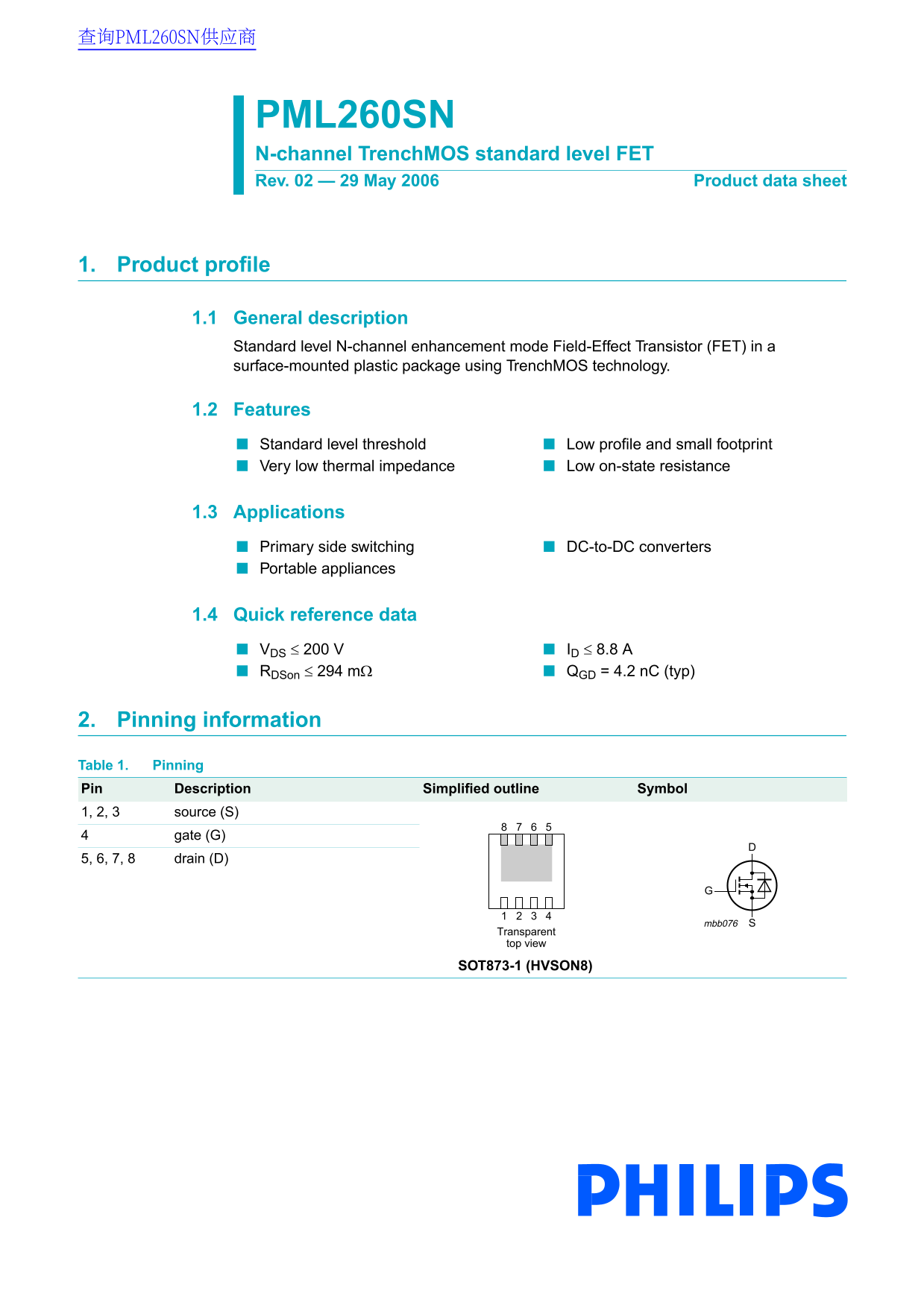
2. Pinning information Table 1. Pinning Pin Description Simplified outline Symbol 1, 2, 3 source (S)
gate (G)
5, 6, 7, 8 drain (D)
mbb076
Transparent top view
SOT873-1 (HVSON8)
Page Summary Contents For Philips PML260SN Data Sheet
Manual Details
| Brand | Philips |
|---|---|
| Pages | 12 |
| File Size | 76.68 KB |
| Published | July 06, 2026 |
Enter the captcha to get the download link:

Frequently Asked Questions
What voltage range does the PML260SN FET support?
The drain-source voltage (VDS) is rated up to 200 V in optimal conditions.
What are the primary applications for this N-channel Transistor?
It is designed for use in primary side switching, DC-to-DC converters, and portable appliances.
How is the device packaged and mounted?
It uses a surface-mounted plastic package designated as HVSON8 (SOT873-1).
What are the absolute maximum limits for power dissipation?
The total power dissipation (Ptot) can reach -50 Wmb at 25°C.