# A B C D E F G H I J K L M N O P Q R S T U V W X Y Z

Dell Systems Build and Update Utility Version 1.5 Readme

Summary

Dell Systems Build and Update Utility version 1.5 readme documenting a deployment tool for installing operating systems, viewing hardware details, performing firmware updates, generating hardware configuration scripts, and creating bootable images. Supports Windows Server 2003/2008, Red Hat Enterprise Linux, SUSE Linux, and VMware ESX. Includes installation instructions, known issues, CLI syntax for SBU commands, and system requirements. Intended for IT administrators deploying and provisioning Dell server systems at scale.
📄 Preview 📖 Table of Contents Contents PAGE OF 16

Page 1 Text Content

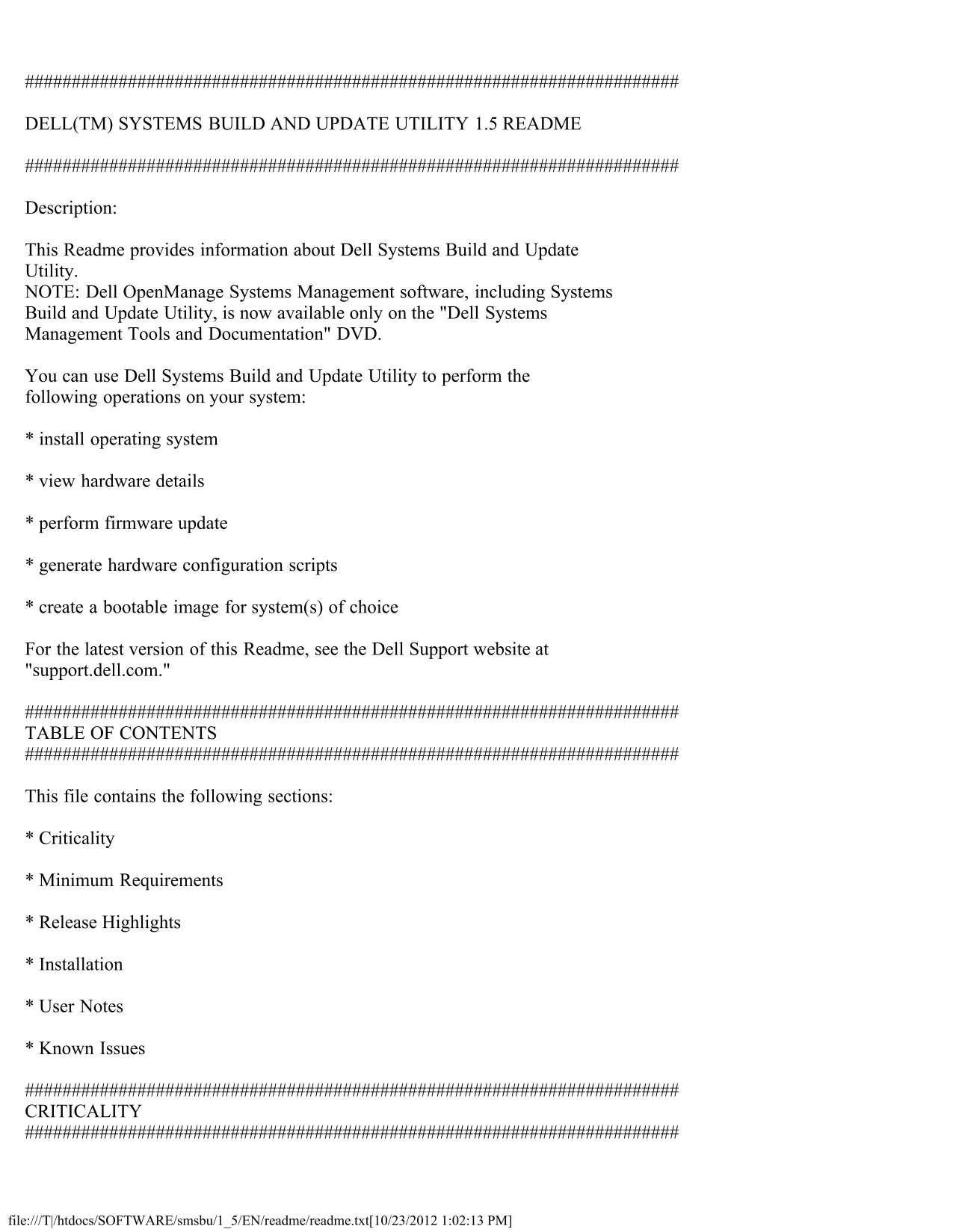
DELL(TM) SYSTEMS BUILD AND UPDATE UTILITY 1.5 README

Description:

This Readme provides information about Dell Systems Build and Update Utility. NOTE: Dell Open Manage Systems Management software, including Systems Build and Update Utility, is now available only on the "Dell Systems Management Tools and Documentation" DVD.

You can use Dell Systems Build and Update Utility to perform the following operations on your system:

* install operating system

* view hardware details

* perform firmware update

* generate hardware configuration scripts

* create a bootable image for system(s) of choice

For the latest version of this Readme, see the Dell Support website at "support.dell.com."

TABLE OF CONTENTS

This file contains the following sections:

* Criticality

* Minimum Requirements

* Release Highlights

* Installation

* User Notes

* Known Issues

CRITICALITY

file:///T|/htdocs/SOFTWARE/smsbu/1_5/EN/readme/readme.txt[10/23/2012 1:02:13 PM]

Page Summary Contents For Dell Systems Build and Update Utility Version 1.5 Readme

Page 1 DELL(TM) SYSTEMS BUILD AND UPDATE UTILITY 1.5 README Description: This Readme provides information about Dell Systems Build and Update Utility. NOTE: Dell Open Manage Systems Management software, incl...
Page 2 3 = Optional Dell recommends that you review specifics about the update to determine if it applies to your system. The update contains changes that impact only certain configurations, or provides new ...
Page 3 * Novell(R) SUSE LINUX Enterprise Server (SLES) 11 SP1 x86-64 * VMware ESX version - 4.1, 4.0 U2 * VMware ESXi Installer and Recovery, version - 4.1, 4.0 U2 * Citrix Xen 5.6 HDD * Microsoft Windows Se...
Page 4 3. Each of the above modules can be configured independently, and all the configurations can then be applied in one go. Alternatively,the Server OS Installation can be done by itself in one flow. To c...
Page 5 * If the Systems Build and Update Utility GUI disappear and a blank screen is displayed, restart your system. This issue occurs if you right-click to open a new browser window (from the "Quick Re...
Page 6 * USB keys formatted with NT File System (NTFS) or file allocation table (FAT16) are not supported. * Any network or Windows share or CD/DVD that you use an input to the Repository must not contain an...
Page 7 are shown during configuration time. However, options that are not shown during configuration, but are part of multi-sys-config.csv file will be ignored. Note: If there is any overlap in the settings ...
Page 8 * A dialog box displays that an Expanded Memory Support (EMS) connection has been discovered during the operating system installation. * You enter the organization name and computer name, an error mes...
Page 9 of the Red Hat Enterprise Linux installation will result in denial of access to the root "log in." * Systems Build and Update Utility limits the maximum block device size on a Linux system t...
Page 10 Administrator Compatibility Guide" and the "Dell Systems Software Support Matrix." * On a system with Embedded SD card slot, if ESXi Installer and recovery OS is supported, it is shown ...
Page 11 to "Native Mode" in the BIOS setup or configure RAID using the "Ctrl+A" option. * If a USB flash device is connected to the system, Systems Build and Update Utility may fail to ins...
Page 12 * The Server Setup program might fail if it runs when scrubbing is active on a RAID virtual disk. * Systems Build and Update Utility does not identify the boot device when PERC 4DC controller is in cl...
Page 13 Virtual Disk which is created on the controller connecting to an external storage enclosure. * i DRAC users created through SBUU do not get enabled. To enable these users, user will have to go to DRAC...
Page 14 * CERC ATA 4ch NOTE: In the above case, the option to install Red Hat Enterprise Linux (version 4) will not be presented in the "Select Operating Systems" page. * Installation of Red Hat Ent...
Page 15 - Add the kernel parameter acpi=noirq to the kernel command line to prevent the linux kernel from using the I/O APIC interrupt controllers. A fix for this would be available in a future update BIOS re...
Page 16 the USB devices there instead of mounting to /tmp Information in this document is subject to change without notice. (C) 2010 Dell Inc. All rights reserved. Reproduction in any manner, whatsoever witho...

Manual Details

Brand Dell
Pages 16
File Size 45.49 KB
Published June 26, 2026
10 views

Enter the captcha to get the download link:

captcha

Frequently Asked Questions

What operating systems are supported by this utility?

Supported OSs include Windows Server 2003/2008/2008 R2, RHEL 5/6, SLES 10/11, VMware ESX/ESXi 4.0/4.1, and Citrix Xen.

What are the system requirements for running the utility?

A supported Dell system with a minimum of 512 MB memory and a DVD drive is required.

Which Dell PowerEdge and PowerVault systems are supported?

Supported systems include the R200, R210, R300, R410, R510, R610, R710, R810, R910, T110, T300, T310, T410, T610, M600, M610, M710, and PowerVault 110, 500, 600, and DL 2000.

Can I create a bootable image with this utility?

Yes, you can use it to create a bootable image for system(s) of choice.