Cypress CY22393 CY22394 CY22395 Three-PLL Serial-Programmable Flash-Programmable Clock Generator User Manual, Specifications
Summary
This manual provides comprehensive technical documentation for a versatile Flash-Programmable Clock Generator family (CY22393, CY22394, CY22395). These advanced clock generators utilize three integrated PLLs to generate multiple unique and high-accuracy frequencies. Designed for demanding applications in multimedia, industrial controls, and communications, the devices offer sophisticated features like 0 ppm frequency generation, low jitter outputs, and field/in-system programmability. The guide covers detailed performance curves, configuration options, and system integration details crucial for engineers seeking highly precise clock solutions across various voltage levels.
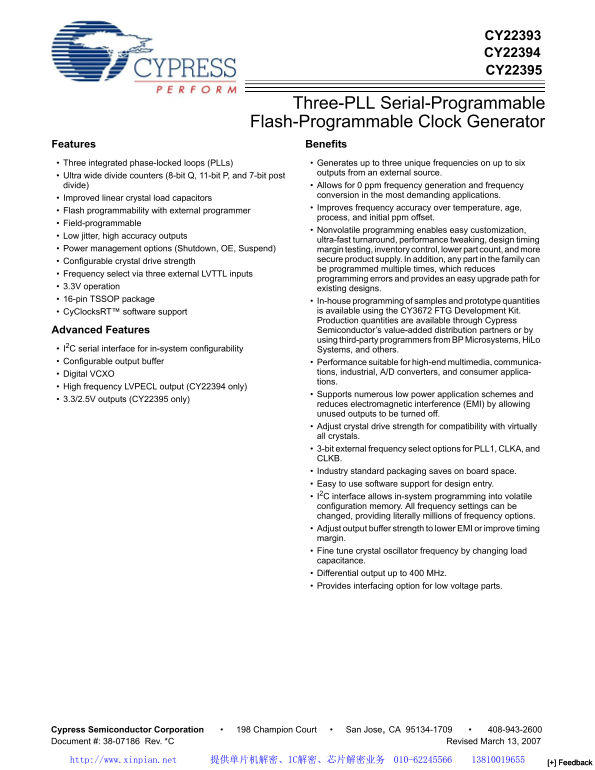
Page 1 Text Content
CY22393 CY22394 CY22395
Three-PLL Serial-Programmable Flash-Programmable Clock Generator
Features Benefits Three integrated phase-locked loops (PLLs) Generates up to three unique frequencies on up to six
outputs from an external source.
Ultra wide divide counters (8-bit Q, 11-bit P, and 7-bit post divide) Allows for 0 ppm frequency generation and frequency
conversion in the most demanding applications.
Improved linear crystal load capacitors
Improves frequency accuracy over temperature, age,
Flash programmability with external programmer
process, and initial ppm offset.
Field-programmable
Nonvolatile programming enables easy customization,
Low jitter, high accuracy outputs
ultra-fast turnaround, performance tweaking, design timing
Power management options (Shutdown, OE, Suspend) margin testing, inventory control, lower part count, and more
Configurable crystal drive strength secure product supply. In addition, any part in the family can be programmed multiple times, which reduces
Frequency select via three external LVTTL inputs
programming errors and provides an easy upgrade path for
3.3V operation existing designs. 16-pin TSSOP package In-house programming of samples and prototype quantities
Cy Clocks RT™ software support is available using the CY3672 FTG Development Kit. Production quantities are available through Cypress Advanced Features Semiconductor’s value-added distribution partners or by using third-party programmers from BP Microsystems, Hi Lo
I2C serial interface for in-system configurability Systems, and others. Configurable output buffer Performance suitable for high-end multimedia, communica-
Digital VCXO tions, industrial, A/D converters, and consumer applica- tions.
High frequency LVPECL output (CY22394 only)
Supports numerous low power application schemes and
3.3/2.5V outputs (CY22395 only)
reduces electromagnetic interference (EMI) by allowing unused outputs to be turned off. Adjust crystal drive strength for compatibility with virtually all crystals. 3-bit external frequency select options for PLL1, CLKA, and CLKB. Industry standard packaging saves on board space. Easy to use software support for design entry. I2C interface allows in-system programming into volatile configuration memory. All frequency settings can be changed, providing literally millions of frequency options. Adjust output buffer strength to lower EMI or improve timing margin. Fine tune crystal oscillator frequency by changing load capacitance. Differential output up to 400 MHz. Provides interfacing option for low voltage parts.
Cypress Semiconductor Corporation 198 Champion Court San Jose, CA 95134-1709 408-943-2600 Document #: 38-07186 Rev. *C Revised March 13, 2007
提供单片机解密、IC解密、芯片解密业务 010-62245566 13810019655
[+] Feedback http://www.xinpian.net
Page Summary Contents For Cypress CY22393 CY22394 CY22395 Three-PLL Serial-Programmable Flash-Programmable Clock Generator User Manual, Specifications
Manual Details
| Brand | Cypress |
|---|---|
| Pages | 17 |
| File Size | 317.39 KB |
| Published | May 18, 2026 |
Enter the captcha to get the download link:

Frequently Asked Questions
How can the device be programmed and customized?
It is flash programmable using an external programmer or configured in-system via the IC serial interface.
Does it support low voltage or high frequency output standards?
Yes, it supports 2.5V/3.3V outputs (CY22395) and provides a high frequency LVPECL output (CY22394).
How can I improve signal quality or stability for my design?
You can fine-tune crystal frequency by changing load capacitance, or reduce EMI by adjusting the unused outputs.
Is this device suitable for life-support systems or critical control applications?
No. It is not warranted and generally unsuited for medical, life support, or critical safety applications without written agreement.