3M Scotch 23 All-Voltage Splicing Tape User Guide
Summary
This advanced Scotch™ splicing tape provides superior electrical insulation for solid dielectric cables up to 69kV. Made from high-performance EPR rubber, it is highly conformable, self-fusing, and maintains integrity even at elevated temperatures. This guide details crucial technical data sheets, including electrical properties, detailed installation techniques (for various voltages), and best practices for splicing and terminating XLPE, PVC, and other synthetic cable insulations. Ideal for professional electricians and engineers performing high-voltage cable repairs and installations.
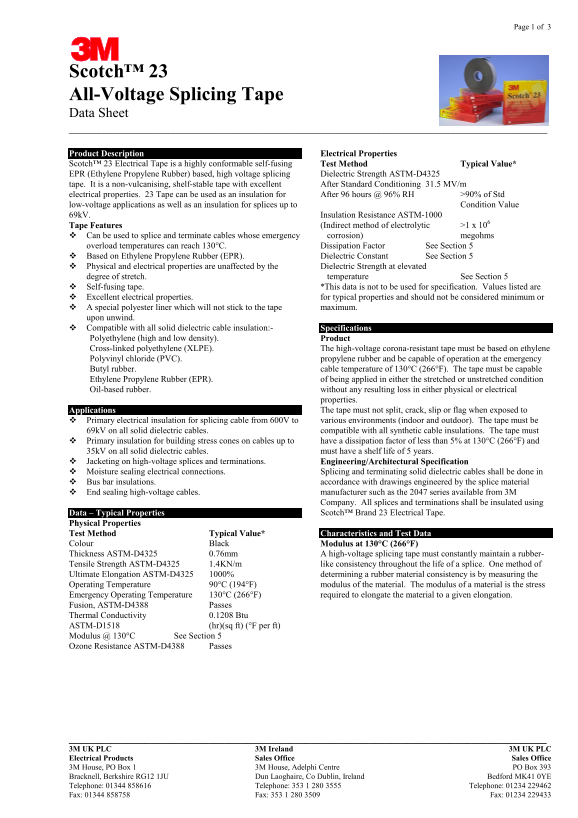
Page 1 Text Content
Page 1 of 3
Scotch™ 23 All-Voltage Splicing Tape Data Sheet
Product Description Electrical Properties
Scotch™ 23 Electrical Tape is a highly conformable self-fusing Test Method Typical Value*
EPR (Ethylene Propylene Rubber) based, high voltage splicing Dielectric Strength ASTM-D4325 tape. It is a non-vulcanising, shelf-stable tape with excellent After Standard Conditioning 31.5 MV/m electrical properties. 23 Tape can be used as an insulation for After 96 hours @ 96% RH >90% of Std
low-voltage applications as well as an insulation for splices up to Condition Value
69k V. Insulation Resistance ASTM-1000 Tape Features (Indirect method of electrolytic >1 x 10⁶
Can be used to splice and terminate cables whose emergency corrosion) megohms overload temperatures can reach 130°C. Dissipation Factor See Section 5 Based on Ethylene Propylene Rubber (EPR). Dielectric Constant See Section 5 Physical and electrical properties are unaffected by the Dielectric Strength at elevated degree of stretch. temperature See Section 5 Self-fusing tape. *This data is not to be used for specification. Values listed are Excellent electrical properties. for typical properties and should not be considered minimum or A special polyester liner which will not stick to the tape maximum. upon unwind. Compatible with all solid dielectric cable insulation:- Specifications Polyethylene (high and low density). Product Cross-linked polyethylene (XLPE). The high-voltage corona-resistant tape must be based on ethylene Polyvinyl chloride (PVC). propylene rubber and be capable of operation at the emergency Butyl rubber. cable temperature of 130°C (266°F). The tape must be capable Ethylene Propylene Rubber (EPR). of being applied in either the stretched or unstretched condition Oil-based rubber. without any resulting loss in either physical or electrical
properties. Applications The tape must not split, crack, slip or flag when exposed to Primary electrical insulation for splicing cable from 600V to various environments (indoor and outdoor). The tape must be 69k V on all solid dielectric cables. compatible with all synthetic cable insulations. The tape must Primary insulation for building stress cones on cables up to have a dissipation factor of less than 5% at 130°C (266°F) and 35k V on all solid dielectric cables. must have a shelf life of 5 years.
Jacketing on high-voltage splices and terminations. Engineering/Architectural Specification
Moisture sealing electrical connections. Splicing and terminating solid dielectric cables shall be done in Bus bar insulations. accordance with drawings engineered by the splice material End sealing high-voltage cables. manufacturer such as the 2047 series available from 3M Company. All splices and terminations shall be insulated using Data – Typical Properties Scotch™ Brand 23 Electrical Tape.
Physical Properties Test Method Typical Value* Characteristics and Test Data Colour Black Modulus at 130°C (266°F) Thickness ASTM-D4325 0.76mm A high-voltage splicing tape must constantly maintain a rubber- Tensile Strength ASTM-D4325 1.4KN/m like consistency throughout the life of a splice. One method of Ultimate Elongation ASTM-D4325 1000% determining a rubber material consistency is by measuring the Operating Temperature 90°C (194°F) modulus of the material. The modulus of a material is the stress Emergency Operating Temperature 130°C (266°F) required to elongate the material to a given elongation. Fusion, ASTM-D4388 Passes Thermal Conductivity 0.1208 Btu ASTM-D1518 (hr)(sq ft) (°F per ft) Modulus @ 130°C See Section 5 Ozone Resistance ASTM-D4388 Passes
3M UK PLC 3M Ireland 3M UK PLC Electrical Products Sales Office Sales Office 3M House, PO Box 1 3M House, Adelphi Centre PO Box 393 Bracknell, Berkshire RG12 1JU Dun Laoghaire, Co Dublin, Ireland Bedford MK41 0YE Telephone: 01344 858616 Telephone: 353 1 280 3555 Telephone: 01234 229462 Fax: 01344 858758 Fax: 353 1 280 3509 Fax: 01234 229433
Page Summary Contents For 3M Scotch 23 All-Voltage Splicing Tape User Guide
Manual Details
| Brand | 3M |
|---|---|
| Pages | 3 |
| File Size | 136.16 KB |
| Published | May 12, 2026 |
Enter the captcha to get the download link:

Frequently Asked Questions
What is the shelf life of Scotch™ 23 Electrical Tape?
Under normal storage conditions, the tape has a 5-year shelf life and is not impaired by freezing.
How should I wrap the splicing tape for optimal coverage?
Always attempt to half-lap to produce a uniform build-up. When wrapping in critical areas, stretch the tape just short of its breaking point.
What type of solid dielectric cables can this tape insulate?
It is compatible with all solid dielectric cable insulation, including Polyethylene (high and low density), XLPE, PVC, butylene rubber, and oil-based rubber.
Can Scotch™ 23 handle multiple voltage levels?
The tape is rated for primary electrical insulation for splicing cables from 600V to 69kV on all solid dielectric cables.